ثبت نام / ورود
0
ثبت نام / ورود
0
Communicate with Daemons, Agents, and Helpers Through XPC
Volodymyr Vashurkin
#macOS
#Daemonology
#Daemon
#XPC
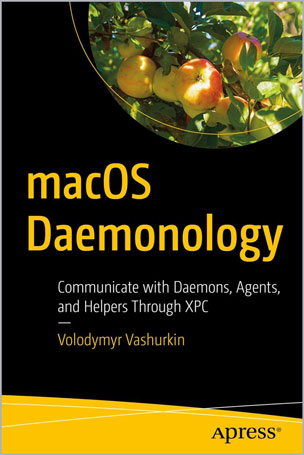
Take advantage of the full power of Swift through XPC. Development for macOS differs from iOS and web-based development because of multicomponent applications. Besides the usual GUI-based applications and app extensions, there are a wide range of daemons—processes that run in the background—to worry about. These include system monitoring, event listening, notification agents, and many-many more.
First, you'll take a tour around different types of daemons: user agents, privileged helpers, login items, XPC services, and System Extensions. Knowing key specifics of the daemons will open a wide range of possibilities from non-trivial application development to system development. You'll find lots of examples, working code samples, and even ready-to-use utilities. The book will guide you step-by-step through preparation, registration, and management of all kinds of daemons.
System Extensions are brand new for macOS and open additional powerful features for developers. You'll explore installation, user flow, and communication with System Extensions, too, with examples, of course. XPC provides an object-oriented way of communication. There’s no need for custom byte/text-based protocols. A good macOS developer has to know not only programming interfaces, but also design patterns related to technology. XPC communication has a few patterns of its own, and we'll go through them all, including uni- and bi-directional communication, passing objects by-value and by-proxy, handling connection invalidation, named and anonymous connections, and many more.
What You'll Learn
Who This Book Is For
Software developers and solution architects with at least a working knowledge of macOS and Swift programming. As overview, may be interested for software/solution architects.
Table of Contents
Part I: Daemons in a wild
Chapter 1: Operating System Background World
Chapter 2: Daemon Anatomy
Chapter 3: Daemon Management
Part II: Daemons in Detail
Chapter 4: Daemons at a Glance
Chapter 5: Classic Daemon
Chapter 6: Privileged Helper
Chapter 7: System Extensions (Since macOS 10.15)
Chapter 8: User Agents
Chapter 9: XPC Services
Chapter 10: Login Items
Part Ill: Talking to your daemons
Chapter 11: XPC at a Glance
Chapter 12: Pass Objects by Copy Over XPC Using NSSecureCoding
Chapter 13: Pass Objects by Proxy: The Callable XPC Objects
Chapter 14: NSXPCListener Endpoint: XPC Service Sharing
Chapter 15: XPC Security
Chapter 16: XPC and Swift
Volodymyr Vashurkin is an experienced macOS system and security developer and engineer. His first steps in daemonology were made while researching FileVault full disk encryption on macOS, and its interaction with iCloud services. iCloud on macOS uses plenty of system daemons and user agents, and investigating macOS’s infrastructure led to a solid understanding of how the background world of macOS works. This led him deeply into the development of security solutions for macOS. Working in the security area, Volodymyr gained practical skills for creating GUI-based applications with fewer user agents (user background processes) and root daemons (root'ed background processes). In developing his knowledge and skills, Volodymyr faced numerous tricky cases, lack of documentation, and minor and major documentation gaffes. He would like to help his readers avoid the same pitfalls.