ثبت نام / ورود
0
ثبت نام / ورود
0
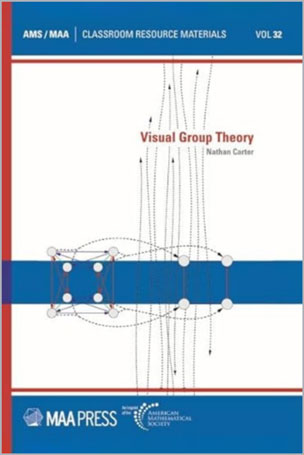
Nathan C. Carter
#Group_Theory
#Algebra
#Homomorphisms
#Galois_theory
Recipient of the Mathematical Association of America's Beckenbach Book Prize in 2012!
Group theory is the branch of mathematics that studies symmetry, found in crystals, art, architecture, music and many other contexts, but its beauty is lost on students when it is taught in a technical style that is difficult to understand. Visual Group Theory assumes only a high school mathematics background and covers a typical undergraduate course in group theory from a thoroughly visual perspective. The more than 300 illustrations in Visual Group Theory bring groups, subgroups, homomorphisms, products, and quotients into clear view. Every topic and theorem is accompanied with a visual demonstration of its meaning and import, from the basics of groups and subgroups through advanced structural concepts such as semidirect products and Sylow theory.
Table of Contents
1 What is a group?
2 What do groups look like?
3 Why study groups?
4 Algebra at last
5 Five families
6 Subgroups
7 Products and quotients
8 The power of homomorphisms
9 Sylow theory
10 Galois theory
Answers to selected Exercises
Carter presents the group theory portion of abstract algebra in a way that allows students to actually see, using a multitude of examples and applications, the basic concepts of group theory … The numerous images (more than 300) are the heart of the text. As this work enables readers to see, experiment with, and understand the significance of groups, they will accumulate examples of groups and their properties that will serve them well in future endeavors in mathematics. Recommended.- J. T. Zerger, Choice;
""If you teach abstract algebra, then this book should be a part of the resources you use. While the phrase “visual abstract algebra” may seem to be a contradiction, the diagrams in this book are an existence proof to the contrary. They are clear, colorful and concise, very easy to understand and sure to aid the students that have difficulty in internalizing the abstract nature of the subject matter …""- Charles Ashbacher, Journal of Recreational Mathematics
About the Author
Nathan C. Carter is a mathematician and educator associated with Bentley University, known particularly for his work in mathematical education and technology. He is the author of Visual Group Theory, a book that uses diagrams and visual methods to make abstract mathematical concepts more accessible, and he has collaborated with Kenneth Monks on Lurch, an open-source mathematical word processor designed to provide students with feedback while they work through mathematical proofs.