ثبت نام / ورود
0
ثبت نام / ورود
0
Yiping Zhao, Yoong Sheng Phang
#Smartphones
#Optical_Experimentation
#Optical
#LED
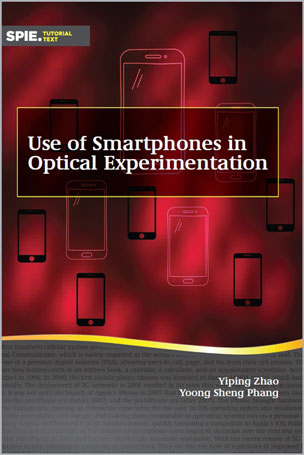
Use of Smartphones in Optical Experimentation shows how smartphone-based optical labs can be designed and realized. The book presents demonstrations of fundamental geometric and physical optical principles, including the law of reflection, the law of refraction, image formation equations, dispersion, Beer’s law, polarization, Fresnel’s equations, optical rotation, diffraction, interference, and blackbody radiation. Many practical applications―how to design a monochromator and a spectrometer, use the Gaussian beam of a laser, measure the colors of LED lights, and estimate the temperature of an incandescent lamp or the Sun―are also included. The experimental designs provided in this book represent only a hint of the power of leveraging the technological capability of smartphones and other low-cost materials to create a physics lab.
This book can be used as a guide for undergraduate students and instructors for a hands-on experience with optics, especially for an online optical lab; elementary and high school science teachers to develop smartphone-based labs for classroom demonstrations; and anyone who wants to explore fundamental STEM concepts by designing and performing experiments anywhere.
Table of Contents
1 Smartphones and Their Optical Sensors
2 Experimental Data Analysis
3 Law of Reflection
4 Law of Refraction
5 Image Formation
6 Linear Polarization
7 Fresnel Equations
8 Brewster’s Angle
9 Optical Rotation
10 Thin Film Interference
11 Wedge Interference
12 Diffraction from Gratings
13 Structural Coloration of Butterfly Wings and Peacock Feathers
14 Optical Rangefinder Based on Gaussian Beam of Lasers
15 Monochromator
16 Optical Spectrometers
17 Dispersion
18 Beer’s Law
19 Optical Spectra of Incandescent Lightbulbs and LEDs
20 Blackbody Radiation of the Sun
21 Example Course Instructions for Smartphone-based Optical Labs