ثبت نام / ورود
0
ثبت نام / ورود
0
Richard L. Sites
#Software
#SSD
#CPU
#x86
#ARM
#KUtrace
#Ethernet
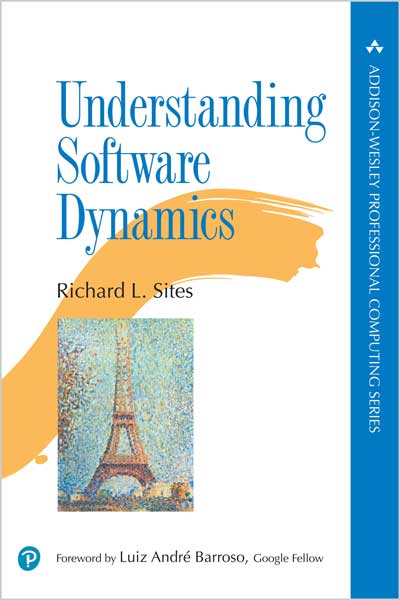
An Expert Guide to Software Performance Optimization
From mobile and cloud apps to video games to driverless vehicle control, more and more software is time-constrained: It must deliver reliable results seamlessly, consistently, and virtually instantaneously. If it doesn't, customers are unhappy--and sometimes lives are put at risk. When complex software underperforms or fails, software engineers need to identify and address the root causes. This is difficult and, historically, few tools have been available to help.
In Understanding Software Dynamics, performance expert Richard L. Sites tackles the problem head on, offering expert methods and advanced tools for understanding complex, time-constrained software dynamics, improving reliability and troubleshooting challenging performance problems.
Sites draws on several decades of experience pioneering software performance optimization, as well as extensive experience teaching graduate-level developers. He introduces principles and techniques for use in any environment, from embedded devices to datacenters, illuminating them with examples based on x86 or ARM processors running Linux and linked by Ethernet. He also guides readers through building and applying a powerful, new, extremely low-overhead open-source software tool, KUtrace, to precisely trace executions on every CPU core. Using insights gleaned from this tool, readers can apply nuanced solutions--not merely brute-force techniques such as turning off caches or cores.
Understanding Software Dynamics will be valuable to experienced software professionals, including application and OS developers, hardware and system architects, real-time system designers, and game developers, as well as advanced students.
Table of Contents
Part I: Measurement
1 My Program Is Too Slow
2 Measuring CPUs
3 Measuring Memory
4 CPU and Memory Interaction
5 Measuring Disk/SSD
6 Measuring Networks
7 Disk and Network Database Interaction
Part II: Observation
8 Logging
9 Aggregate Measures
10 Dashboards
11 Other Existing Tools
12 Traces
13 Observation Tool Design Principles
Part III: Kernel-User Trace
14 KUtrace: Goals, Design, Implementation
15 KUtrace: Linux Kernel Patches
16 KUtrace: Linux Loadable Module
17 KUtrace: User-Mode Runtime Control
18 KUtrace: Postprocessing
19 KUtrace: Display of Software Dynamics
Part IV: Reasoning
20 What to Look For
21 Executing Too Much
22 Executing Slowly
23 Waiting for CPU
24 Waiting for Memory
25 Waiting for Disk
26 Waiting for Network
27 Waiting for Locks
28 Waiting for Time
29 Waiting for Queues
30 Recap
Appendix A: Sample Servers
Appendix B: Trace Entries
"Complex software often uses threads, events, and I/O to produce results. Even intermittent performance bugs can lead to functional failures when results are time sensitive. Here Sites shares his methods from decades of experience as a real-world performance detective to enable you to approach the deduction skills of an IT Sherlock Holmes."
―Mark D. Hill, Partner Hardware Architect at Microsoft and Professor Emeritus at the University of Wisconsin-Madison
"I think that any senior CS student or professional can benefit by reading this book. While all the material in the first half of the book leads up to the use of KUTrace, the first two parts are worth reading on their own by anyone who wants to better understand the systems they are building and using."―Rik Farrow, ;login
Richard L. Sites wrote his first computer program in 1959 and has spent most of his career at the boundary between hardware and software, with a particular interest in CPU/software performance interactions. His past work includes VAX microcode, DEC Alpha co-architect, and inventing the performance counters found in nearly all processors today. He has done low-overhead microcode and software tracing at DEC, Adobe, Google, and Tesla. Dr. Sites earned his PhD at Stanford in 1974; he holds 66 patents and is a member of the US National Academy of Engineering.