ثبت نام / ورود
0
ثبت نام / ورود
0
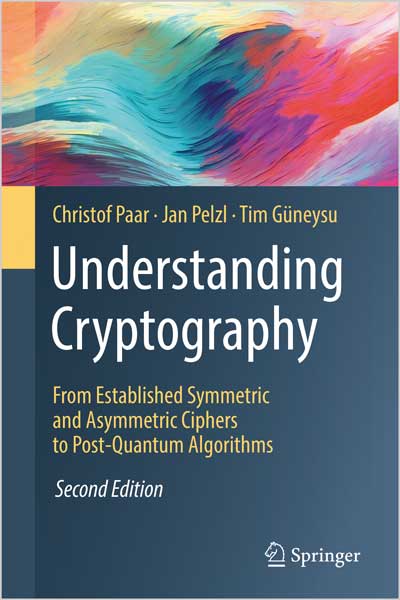
From Established Symmetric and Asymmetric Ciphers to Post-Quantum Algorithms
Christof Paar, Jan Pelzl, Tim Güneysu
#Cryptography
#Algorithms
#Data_Security
#blockchain
#DES
#AES
#MACS
Understanding and employing cryptography has become central for securing virtually any digital application, whether user app, cloud service, or even medical implant.
Heavily revised and updated, the long-awaited second edition of Understanding Cryptography follows the unique approach of making modern cryptography accessible to a broad audience, requiring only a minimum of prior knowledge. After introducing basic cryptography concepts, this seminal textbook covers nearly all symmetric, asymmetric, and post-quantum cryptographic algorithms currently in use in applications―ranging from cloud computing and smart phones all the way to industrial systems, block chains, and cryptocurrencies.
Topics and features:
This must-have book is indispensable as a textbook for graduate and advanced undergraduate courses, as well as for self-study by designers and engineers.
The authors have more than 20 years’ experience teaching cryptography at various universities in the US and Europe. In addition to being renowned scientists, they have extensive experience with applying cryptography in industry, fromwhich they have drawn important lessons for their teaching.
Table of Contents
Chapter 1 Introduction to Cryptography and Data Security
Chapter 2 Stream Ciphers
Chapter 3 The Data Encryption Standard (DES) and Alternatives
Chapter 4 The Advanced Encryption Standard (AES)
Chapter 5 More About Block Ciphers
Chapter 6 Introduction to Public-Key Cryptography
Chapter 7 The RSA Cryptosystem
Chapter 8 Cryptosystems Based on the Discrete Logarithm Problem
Chapter 9 Elliptic Curve Cryptosystems
Chapter 10 Digital Signatures
Chapter 11 Hash Functions
Chapter 12 Post-Quantum Cryptography
Chapter 13 Message Authentication Codes (MACS)
Chapter 14 Key Management
About the Author
The authors have more than 20 years’ experience teaching cryptography at various universities in the US and Europe. In addition to being renowned scientists, they have extensive experience with applying cryptography in industry, from which they have drawn important lessons for their teaching.