ثبت نام / ورود
0
ثبت نام / ورود
0
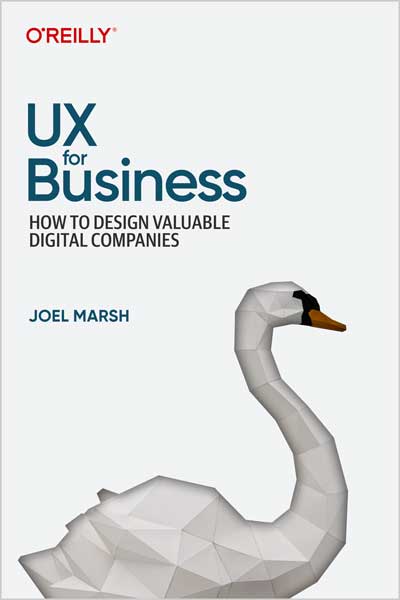
How to Design Valuable Digital Companies
Joel Marsh
#UX
#Business
#design
#AI
#SaaS
#PaaS
#VDP
#B2B
Many UX designers are surprised to learn that much of the job isn't about drawing things. It's about knowing what to draw and how to convince people to build it. Whether you're a one-person design team making products from scratch or a C-level product leader managing many products and strategies, UX for Business is your missing guide to real-world business design.
You'll not only learn how to think about design as a professional but also discover how design can move the needle for your entire company. Author Joel Marsh helps you understand stakeholders, business models, the process of designing valuable solutions, dangerous choices that can ruin a product, and how to gain the attention your work deserves. You'll also explore the principles of designing common types of digital products and services, from portfolio sites to social networks to ecosystems.
With this book, you'll learn:
Contents:
The What
The Who
How This Book Is Organized
In UX, the right answer is often “it depends.” Although the fundamentals remain the same, good UX depends on the situation. The secret is knowing how it depends, and that’s how this book is organized.
There are two broad categories of “it depends” that you must understand: the what, and the who.
“The What” (the first section of the book) is about what you should design. Is it an ecommerce store or B2B software? Is it a small, new startup or a huge, mature company? Is it an app for a brand or an app that should make money? Do users want to save time or kill time? Are you making a product from scratch or optimizing a landing page? And optimizing for what?! Clicks? Sign-ups? World domination? Different UX problems should be solved differently. In each situation, you could cause positive or negative results, or might not make an impact at all. Do you know the difference before you start designing? After reading “The What” section of this book, you will. It contains many examples of how different design situations should change the way you apply the fundamentals of UX.
“The Who” is the second section of this book, and it deals with the people affected by your work. Users are definitely part of it—whether we call them customers, audiences, segments, or personas—but everybody teaches that part! But users are not the whole story. The hard part is the people you work with. Clients, managers, designers and engineers, executives and finance people, sales and marketing people, and everyone else who might have the power to say no to you. We usually call them stakeholders. Ugh. It makes me shiver just writing it.
We will learn about researching, designing your process, and communicating with colleagues to ensure that they see what you see, and feel what you feel. As much as we can, anyway. No matter how much I love them, some backend developers and accountants are beyond the scope of this book.
“The Who” also includes the one person who will influence your work the most: you! Like any good kung fu master will tell you, you cannot master UX until you master yourself.