ثبت نام / ورود
0
ثبت نام / ورود
0
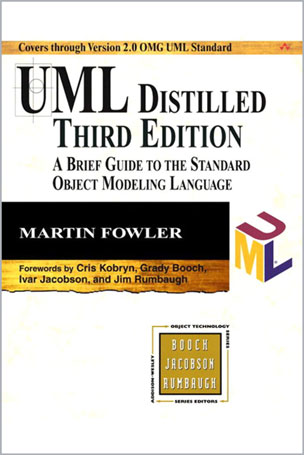
A Brief Guide to the Standard Object Modeling Language
Martin Fowler
#UML2.0
#UML
#Distilled
#Diagrams
More than 300,000 developers have benefited from past editions of UML Distilled . This third edition is the best resource for quick, no-nonsense insights into understanding and using UML 2.0 and prior versions of the UML.
Some readers will want to quickly get up to speed with the UML 2.0 and learn the essentials of the UML. Others will use this book as a handy, quick reference to the most common parts of the UML. The author delivers on both of these promises in a short, concise, and focused presentation.
This book describes all the major UML diagram types, what they're used for, and the basic notation involved in creating and deciphering them. These diagrams include class, sequence, object, package, deployment, use case, state machine, activity, communication, composite structure, component, interaction overview, and timing diagrams. The examples are clear and the explanations cut to the fundamental design logic. Includes a quick reference to the most useful parts of the UML notation and a useful summary of diagram types that were added to the UML 2.0.
If you are like most developers, you don't have time to keep up with all the new innovations in software engineering. This new edition of Fowler's classic work gets you acquainted with some of the best thinking about efficient object-oriented software design using the UML--in a convenient format that will be essential to anyone who designs software professionally.
Table of Contents
Chapter 1: Introduction
Chapter 2: Development Process
Chapter 3: Class Diagrams: The Essentials
Chapter 4: Sequence Diagrams
Chapter 5: Class Diagrams: Advanced Concepts
Chapter 6: Object Diagrams
Chapter 7: Package Diagrams
Chapter 8: Deployment Diagrams
Chapter 9: Use Cases
Chapter 10: State Machine Diagrams
Chapter 11: Activity Diagrams
Chapter 12: Communication Diagrams
Chapter 13: Composite Structures
Chapter 14: Component Diagrams
Chapter 15: Collaborations
Chapter 16: Interaction Overview Diagrams
Chapter 17: Timing Diagrams
About the Author
Martin Fowler
For all of my career I've been interested in the design and architecture of software systems, particularly those loosely classed as Enterprise Applications. I firmly believe that poor software design leads to software that is difficult to change in response to growing needs, and encourages buggy software that saps the productivity of computer users everywhere.
I'm always trying to find out what designs are effective, what approaches lead people into trouble, how we can organize our work to do better designs, and how to communicate what I've learned to more people. My books and website are all ways in which I can share what I learn and I'm glad I've found a way to make a living doing this.