ثبت نام / ورود
0
ثبت نام / ورود
0
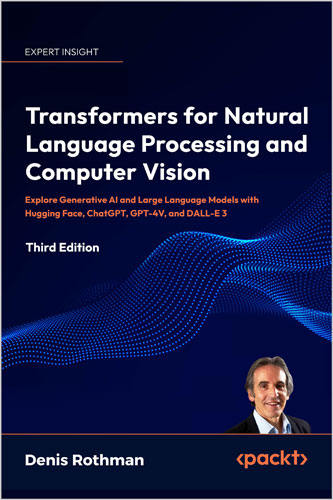
Explore Generative AI and Large Language Models with Hugging Face, ChatGPT, GPT-4V, and DALL-E 3
Denis Rothman
#AI
#Transformers
#GPT-4
#BERT
#Llama
#OpenAI
#Vertex_AI
#Llama
#NLP
#CV
#RAG
#DALL-E
🔹 این کتاب نسخه سوم Transformers for Natural Language Processing and Computer Vision هست و همهی ماجرا رو از صفر تا پیشرفته درباره مدلهای زبانی بزرگ (LLM) توضیح میده — از معماری اصلی ترنسفورمر تا فاینتیونینگ، Retrieval Augmented Generation (RAG)، مدلهای چندمودی (Multimodal Generative AI)، و موضوعات ریسک و پیادهسازی روی پلتفرمهای مختلف (ChatGPT Plus با GPT‑4، Hugging Face، Vertex AI).
این کتاب از معماری ترنسفورمرهای کلاسیک شروع میکنه و تا تازهترین Foundation Models و مدلهای مولد پیش میره. یاد میگیری چطور مدلها رو Pretrain کنی، Fine-Tune انجام بدی، و سناریوهای واقعی مثل خلاصهسازی یا ساخت سیستم پرسشوپاسخ رو با جستجوی مبتنی بر Embedding اجرا کنی.
⚠️ بخش ریسکها رو هم پوشش میده: از Hallucination و Memorization تا چالشهای حریم خصوصی، و روشهای مقابله با اونها مثل Rule Baseها و مدلهای Moderation.
📷 بعد وارد Vision Transformers و مدلهای چندمودی میشه و حتی میره سراغ پروژههای Image/Video-to-Text، ترکیب چند مدل، و مفاهیم AI Agent Replication.
برای مهندسان NLP و CV، دولوپرها، دیتا ساینتیستها، مهندسان ML و لیدرهای فنی که میخوان توی مهارتهای LLM و AI مولد خودشون پیشرفت کنن یا آخرین ترندها رو دنبال کنن عالیه.
📌 نیاز داری Python رو بلد باشی و یک دید کلی از ML داشته باشی. ولی حتی اگر تازهکار باشی، مثالهای رابط کاربری LLM، Prompt Engineering و مدلسازی بدون کدنویسی هم هست.
دنیس رُثمان (Denis Rothman) فارغالتحصیل دانشگاه سوربن و Paris‑Diderot، طراح یکی از اولین سیستمهای Word2Matrix و چتباتهای مکالمهای ثبت اختراع شده. سابقهی ساخت AI Resource Optimizer برای IBM، حلگر APS جهانی و پروژههای NLP تجاری رو داره.
The definitive guide to LLMs, from architectures, pretraining, and fine-tuning to Retrieval Augmented Generation (RAG), multimodal Generative AI, risks, and implementations with ChatGPT Plus with GPT-4, Hugging Face, and Vertex AI
Key Features
Book Description
Transformers for Natural Language Processing and Computer Vision, Third Edition, explores Large Language Model (Llama ) architectures, applications, and various platforms (Hugging Face, OpenAI, and Google Vertex AI) used for Natural Language Processing (NLP) and Computer Vision (CV).
The book guides you through different transformer architectures to the latest Foundation Models and Generative AI. You'll pretrain and fine-tune LLMs and work through different use cases, from summarization to implementing question-answering systems with embedding-based search techniques. You will also learn the risks of LLMs, from hallucinations and memorization to privacy, and how to mitigate such risks using moderation models with rule and knowledge bases. You'll implement Retrieval Augmented Generation (RAG) with LLMs to improve the accuracy of your models and gain greater control over LLM outputs.
Dive into generative vision transformers and multimodal model architectures and build applications, such as image and video-to-text classifiers. Go further by combining different models and platforms and learning about AI agent replication.
This book provides you with an understanding of transformer architectures, pretraining, fine-tuning, LLM use cases, and best practices.
What you will learn
Who this book is for
This book is ideal for NLP and CV engineers, software developers, data scientists, machine learning engineers, and technical leaders looking to advance their LLMs and generative AI skills or explore the latest trends in the field.
Knowledge of Python and machine learning concepts is required to fully understand the use cases and code examples. However, with examples using LLM user interfaces, prompt engineering, and no-code model building, this book is great for anyone curious about the AI revolution.
Table of Contents
Chapter 1: What Are Transformers?
Chapter 2: Getting Started with the Architecture of the Transformer Model
Chapter 3: Emergent vs Downstream Tasks: The Unseen Depths of Transformers
Chapter 4: Advancements in Translations with Google Trax, Google Translate, and Gemini
Chapter 5: Diving into Fine-Tuning through BERT
Chapter 6: Pretraining a Transformer from Scratch through ROBERTa
Chapter 7: The Generative Al Revolution with ChatGPT
Chapter 8: Fine-Tuning OpenAI GPT Models
Chapter 9: Shattering the Black Box with Interpretable Tools
Chapter 10: Investigating the Role of Tokenizers in Shaping Transformer Models
Chapter 11: Leveraging LLM Embeddings as an Alternative to Fine-Tuning
Chapter 12: Toward Syntax-Free Semantic Role Labeling with ChatGPT and GPT-4
Chapter 13: Summarization with T5 and ChatGPT
Chapter 14: Exploring Cutting-Edge LLMs with Vertex Al and PaLM 2
Chapter 15: Guarding the Giants: Mitigating Risks in Large Language Models
Chapter 16: Beyond Text: Vision Transformers in the Dawn of Revolutionary Al
Chapter 17: Transcending the Image-Text Boundary with Stable Diffusion
Chapter 18: Hugging Face AutoTrain: Training Vision Models without Coding
Chapter 19: On the Road to Functional AGI with HuggingGPT and its Peers
Chapter 20: Beyond Human-Designed Prompts with Generative Ideation
(N.B. Please use the Read Sample option to see further chapters)
Denis Rothman graduated from Sorbonne University and Paris-Diderot University, designing one of the very first word2matrix patented embedding and patented AI conversational agents. He began his career authoring one of the first AI cognitive Natural Language Processing (NLP) chatbots applied as an automated language teacher for Moet et Chandon and other companies. He authored an AI resource optimizer for IBM and apparel producers. He then authored an Advanced Planning and Scheduling (APS) solution used worldwide.