ثبت نام / ورود
0
ثبت نام / ورود
0
James Dugundji
#Topology
#Set_theory
#Homotopy
#En
#H-Spaces
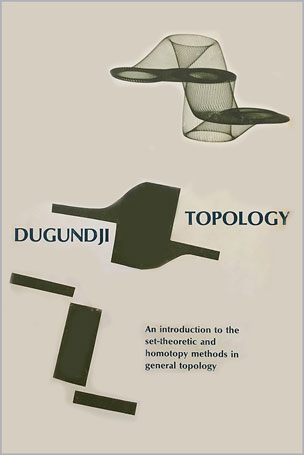
Topology by James Dugundji, published in 1966, is a classic and influential textbook on general topology. It provides a rigorous treatment of the fundamental concepts of topology, including topological spaces, continuity, convergence, compactness, connectedness, separation axioms, and product and quotient spaces. The book is known for presenting topology from a general and abstract viewpoint while emphasizing the connections between topological ideas and other areas of mathematics, particularly analysis and geometry. Although its style is relatively formal and demanding, Topology remains a valuable reference for graduate students and researchers who want a deeper understanding of general topology and its applications.
Table of Contents
I. Elementary set theory
11. Ordinals and Cardinals
111. Topological spaces
IV. Cartesian products
V. Connectedness
VI. Identification Topology; weak topology
VI I. Separation axioms
VIII. Covering axioms
IX. Metric spaces
X. Convergence
XI. Compactness
XI I. Function spaces
XI 11. The spaces C(Y)
XIV. Complete spaces
XV. Homotopy
XVI. Maps into spheres
XVII. Topology of En
XVIII. Homotopy type
XIX. Path spaces; H-Spaces
XIX. Path spaces; H-Spaces
XX. Fiber spaces
Appendix one: Vector spaces; polytopes
Appendix two: Direct and inverse limits
About the Author
James Dugundji (1919–1985) was an American mathematician best known for his contributions to topology and functional analysis. He was born in Romania and later became a professor and researcher in the United States. Dugundji made important contributions to general topology, particularly in areas involving extension theorems, homotopy theory, and topological structures. He is perhaps most widely remembered for his influential textbook Topology, published in 1966, which became a standard reference for students and researchers in topology. His work is valued for its rigor, depth, and systematic presentation of abstract mathematical ideas.