ثبت نام / ورود
0
ثبت نام / ورود
0
John Mason, Leone Burton, Kaye Stacey
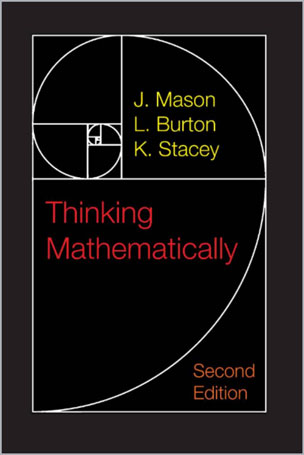
#Thinking
#Mathematically
Thinking Mathematically was published in 1982 and continues to find favour in many different countries. It is used by senior high school students, students going on to study mathematics at university, teacher preparation courses, and in courses for undergraduates in mathematics. The aim in this new edition is to offer a range of questions for exploration appropriate to readers as pre-service primary and secondary teachers, and as mathematics undergraduates. These can be found in the new Chapter 11. Whereas the questions (problems) in the original book were chosen to illustrate the various ‘processes’, or, as we would now put it, the use of various natural powers, the questions in Chapter 11 have been chosen to make use of those powers to enrich and deepen appreciation of core ideas of various important mathematical topics.
A by-product is a demonstration of the way in which ordinary questions, designed to be approached routinely, can sometimes be transformed into intriguing questions. It also demonstrates that significant areas of higher mathematics and sometimes difficult mathematical questions often lie hidden just behind elementary topics. At the same time, we take the opportunity to rephrase the language of thinking processes used in the original book, into the language of natural powers which all human beings possess. This also provides an opportunity to include some insights and distinctions that have emerged in the period since the original was published.
Table of Contents
1 Everyone can start
2 Phases of work
3 Responses to being STUCK
4 ATTACK: conjecturing
5 ATTACK: justifying and convincing
6 Still STUCK?
7 Developing an internal monitor
8 On becoming your own questioner
9 Developing mathematical thinking
10 Something to think about
11 Thinking mathematically in curriculum topics
12 Powers, themes, worlds and attention