ثبت نام / ورود
0
ثبت نام / ورود
0
Martin Bilodeau, David Brenner
#Statistics
#algebra
#Linear_algebra
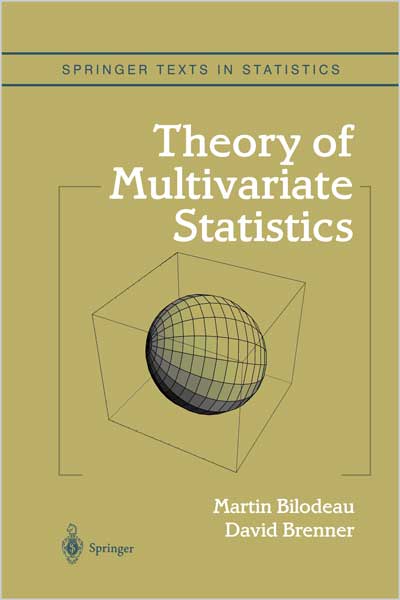
Our object in writing this book is to present the main results of the modern theory of multivariate statistics to an audience of advanced students who would appreciate a concise and mathematically rigorous treatment of that material. It is intended for use as a textbook by students taking a first graduate course in the subject, as well as for the general reference of interested research workers who will find, in a readable form, developments from recently published work on certain broad topics not otherwise easily accessible, as, for instance, robust inference (using adjusted likelihood ratio tests) and the use of the bootstrap in a multivariate setting. The references contains over 150 entries post-1982. The main development of the text is supplemented by over 135 problems, most of which are original with the authors.
A minimum background expected of the reader would include at least two courses in mathematical statistics, and certainly some exposure to the calculus of several variables together with the descriptive geometry of linear algebra. Our book is, nevertheless, in most respects entirely self-contained, although a definite need for genuine fluency in general mathematics should not be underestimated. The pace is brisk and demanding, requiring an intense level of active participation in every discussion. The emphasis is on rigorous proof and derivation. The interested reader would profit greatly, of course, from previous exposure to a wide variety of statistically motivating material as well, and a solid background in statistics at the undergraduate level would obviously contribute enormously to a general sense of familiarity and provide some extra degree of comfort in dealing with the kinds of challenges and difficulties to be faced in the relatively advanced work of the sort with which our book deals. In this connection, a specific introduction offering comprehensive overviews of the fundamental multivariate structures and techniques would be well advised. The textbook A First Course in Multivariate Statistics by Flury (1997), published by Springer- Verlag, provides such background insight and general description without getting much involved in the “nasty” details of analysis and construction. This would constitute an excellent supplementary source. Our book is in most ways thoroughly orthodox, but in several ways novel and unique. In Chapter 1 we offer a brief account of the prerequisite linear algebra as it will be applied in the subsequent development. Some of the treatment is peculiar to the usages of multivariate statistics and to this extent may seem unfamiliar.
Chapter 2 presents in review, the requisite concepts, structures, and devices from probability theory that will be used in the sequel. The approach taken in the following chapters rests heavily on the assumption that this basic material is well understood, particularly that which deals with equality-in-distribution and the Cram´er-Wold theorem, to be used with unprecedented vigor in the derivation of the main distributional results in Chapters 4 through 8. In this way, our approach to multivariate theory is much more structural and directly algebraic than is perhaps traditional, tied in this fashion much more immediately to the way in which the various distributions arise either in nature or may be generated in simulation. We hope that readers will find the approach refreshing, and perhaps even a bit liberating, particularly those saturated in a lifetime of matrix derivatives and jacobians.
As a textbook, the first eight chapters should provide a more than adequate amount of material for coverage in one semester (13 weeks). These eight chapters, proceeding from a thorough discussion of the normal distribution and multivariate sampling in general, deal in random matrices, Wishart’s distribution, and Hotelling’s T2, to culminate in the standard theory of estimation and the testing of means and variances.
The remaining six chapters treat of more specialized topics than it might perhaps be wise to attempt in a simple introduction, but would easily be accessible to those already versed in the basics. With such an audience in mind, we have included detailed chapters on multivariate regression, principal components, and canonical correlations, each of which should be of interest to anyone pursuing further study. The last three chapters, dealing, in turn, with asymptotic expansion, robustness, and the bootstrap, discuss concepts that are of current interest for active research and take the reader (gently) into territory not altogether perfectly charted. This should serve to draw one (gracefully) into the literature.
The authors would like to express their most heartfelt thanks to everyone who has helped with feedback, criticism, comment, and discussion in the preparation of this manuscript. The first author would like especially to convey his deepest respect and gratitude to his teachers, Muni Srivastava of the University of Toronto and Takeaki Kariya of Hitotsubashi University, who gave their unstinting support and encouragement during and after his graduate studies. The second author is very grateful for many discussions with Philip McDunnough of the University of Toronto. We are indebted to Nariaki Sugiura for his kind help concerning the application of Sugiura’s Lemma and to Rudy Beran for insightful comments, which helped to improve the presentation. Eric Marchand pointed out some errors in the literature about the asymptotic moments in Section 8.4.1. We would like to thank the graduate students at McGill University and Universit´e de Montr´eal, Gulhan Alpargu, Diego Clonda, Isabelle Marchand, Philippe St-Jean, Gueye N’deye Rokhaya, Thomas Tolnai and Hassan Younes, who helped improve the presentation by their careful reading and problem solving. Special thanks go to Pierre Duchesne who, as part of his Master Memoir, wrote and tested the S-Plus function for the calculation of the robust S estimate in Appendix C.
M. Bilodeau
D. Brenner
Table of Contents
1. Linear algebra
2. Random vectors
3. Gamma, Dirichlet, and F distributions
4. Invariance
5. Multivariate normal
6. Multivariate sampling
7. Wishart distributions
8. Tests on mean and variance
9. Multivariate regression
10. Principal components
11. Canonical correlations
12. Asymptotic expansions
13. Robustness
14. Bootstrap confidence regions and tests
A. Inversion formulas
B. Multivariate cumulants
C. S-plus functions