ثبت نام / ورود
0
ثبت نام / ورود
0
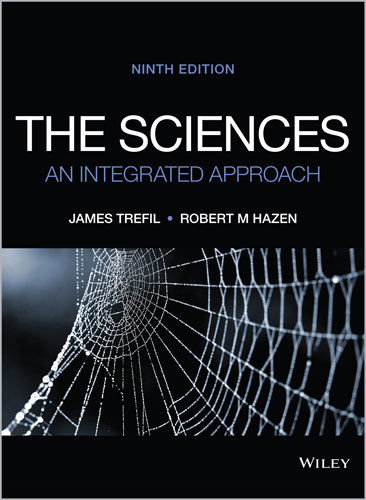
An Integrated Approach
James Trefil, Robert M. Hazen
#Sciences
#Thermodynamics
#Quantum
#Atoms
این کتاب بر این نکته تأکید دارد که علم یک شبکه یکپارچه از دانش در مورد جهان است. این متن فیزیک، شیمی، نجوم، علوم زمین و زیستشناسی را بهطور کامل ادغام کرده و بر اصول کلی و کاربرد آنها در موقعیتهای دنیای واقعی تمرکز دارد. هدف این کتاب کمک به دانشجویان برای دستیابی به سواد علمی است.
ویرایش نهم این کتاب بهدلیل سبک نوشتاری ساده و جزئیات مناسب برای دانشجویان غیرعلمی، مورد تحسین دانشجویان و اساتید قرار گرفته است. این نسخه جدید بهروز شده و آخرین پوششها را در تمام زمینههای علمی به دانشجویان ارائه میدهد، با تأکید بیشتر بر تغییرات اقلیمی، پایداری، ویروسها و بهداشت عمومی و همچنین بهروزرسانی گستردهای در فصل اهمیت بیوانجنیری.
جیمز تریفیل استاد فیزیک در دانشگاه جورج میسون و نویسنده بیش از پنجاه کتاب است. وی عضو انجمن فیزیک آمریکا، AAAS و مجمع جهانی اقتصاد است. بسیاری از آثار منتشر شده وی بر علم برای عموم متمرکز است. کتابهای اخیر وی شامل Cosmic Queries (با نیل دگراس تایسون) و Imagined Life (با مایکل سامرز) است.
رابرت هیزن دانشمند ارشد در آزمایشگاه زمینشناسی موسسه کارنگی و استاد علوم زمین بازنشسته در دانشگاه جورج میسون است. او نویسنده بیش از 400 مقاله و 25 کتاب در زمینههای علم، تاریخ و موسیقی است. کتاب او The Story of Earth به عنوان فینالیست جوایز علمی انجمن سلطنتی و فی بتا کاپا معرفی شد.
The Sciences: An Integrated Approach, 9th Edition by James Trefil and Robert Hazen recognizes that science forms a seamless web of knowledge about the universe. This text fully integrates physics, chemistry, astronomy, Earth sciences, and biology and emphasizes general principles and their application to real world situations. The goal of the text is to help students achieve scientific literacy.
Applauded by students and instructors for its easy-to-read style and detail appropriate for non-science majors, the ninth edition has been updated to bring the most up-to-date coverage to the students in all areas of science, with increased emphasis on climate change, sustainability, viruses and public health, and an extensively updated chapter on the importance of bioengineering.
FEATURES INCLUDE:
The Science of Life - To help show the interdisciplinary nature of the many concepts introduced in the text, sections on living things are included in most chapters. The chapters that emphasize principles specifically related to life are at the end of the book, but the biological examples appear throughout.
The Ongoing Process of Science - Science is a never-ending process of asking questions and seeking answers. In these features, some of the most exciting questions currently being addressed by scientists are examined.
Mathematical Equations and Worked Examples - Whenever an equation is introduced, it is presented in three steps: first as a sentence, second as a word equation, and finally in its traditional symbolic form. In this way, students can focus on the meaning rather than the abstraction of the mathematics. An appendix on English and SI units is also included.
Science by the Numbers - To help students understand the importance of simple mathematical calculations in areas of magnitude, several nontraditional calculations have been incorporated. For example, how much solid waste is generated in the United States, how long it would take to erode a mountain, and how many people were required to build Stonehenge.
Great Ideas and Great Ideas Concept - Each chapter begins with a statement of a great unifying idea or theme in science and a concept map so that students immediately grasp the chief concept of the chapter and how the idea relates to the different branches of science. These statements are intended to provide a framework for placing everyday experiences into a broad context.
Stop and Think! Questions challenge students to think critically about the implications of a scientific discovery or principle.
Resources for Instructors and Students including practice quizzes, flashcards, lecture slides, an instructor’s manual, images and tables from the book, a test bank, and much more!
Table of Contents
1 Science: A Way of Knowing: How do you know what you know?
2 The Ordered Universe: Why do planets appear to wander slowly across the sky?
3 Energy: Why must animals eat to stay alive?
4 Heat and the Second Law of Thermodynamics: Why is it easier to make an omelet from an egg than to make an egg from an omelet
5 Electricity and Magnetism: What is lightning?
6 Waves and Electromagnetic Radiation: What is color?
7 Albert Einstein and the Theoryof Relativity: Can a human ever travel faster than the speed of light, at "warp speed"?
8 The Atom: Why are there so many different materials in the world?
9 Quantum Mechanics: How can the electron behave like both a particle and a wave?
10 Atoms in Combination: The Chemical Bond: How does blood clot?
11 Materials and Their Properties: How have computers gotten so much faster?
12 The Nucleus of the Atom: How do scientists determine the age of the oldest human fossils?
13 The Ultimate Structure of Matter: How can antimatter be used to probe the human brain?
14 The Stars: How much longer can the Sun sustain life on Earth?
15 Cosmology: Will the universe end?
16 Earth and Other Planets: Is Earth the only planet with life?
17 Plate Tectonics: Can we predict destructive earthquakes?
18 Earth's Many Cycles: Will we ever run out of fresh water?
19 Ecology, Ecosystems, and the Environment: Are human activities affecting the global environment?
20 Strategies of Life: What is life?
21 The Living Cell: What is the smallest living thing?
22 Molecules of Life: What constitutes a healthy diet?
23 Classical and Modern Genetics: Why do offspring resemble their parents?
24 The New Science of Life: How did scientists develop a vaccine for COVI D 19?
25 Evolution: How did life emerge on the ancient Earth?
James S. Trefil is the Clarence J Robinson Professor of Physics at George Mason University and author of more than fifty books. He is a Fellow of the American Physical Society, the AAAS, and the World Economic Forum. Much of his published work focuses on science for the general audience. He regularly gives presentations to judges and public officials about the intersections between science and the law. His most recent books are Cosmic Queries, with Neil deGrasse Tyson, which deals with fundamental questions about the universe and was on the New York Times best seller list, and Imagined Life with Michael Summers, which examines the possibility of life on newly discovered exoplanets.
Robert M. Hazen is Senior Staff Scientist at the Carnegie Institution's Geophysical Laboratory and Clarence Robinson Professor of Earth Sciences, Emeritus, at George Mason University. He is author of more than 400 articles and 25 books on science, history, and music. His book The Story of Earth (Viking-Penguin), was finalist in the Royal Society and Phi Beta Kappa science book competitions. A Fellow of the American Association for the Advancement of Science, the Geochemical Society, the American Geophysical Union, and the Geological Society of America, he received the 2021 IMA Medal, the 2016 Roebling Medal, the Mineralogical Society of America Award and MSA's Distinguished Public Service Medal, and the American Chemical Society Ipatieff Prize. In 2012 he was recipient of Virginia's Outstanding Faculty Award. He has presented numerous named lectures and was Distinguished Lecturer for Sigma Xi and MSA, for which he is a past President. The biomineral "hazenite" and the fossil dolphin Cammackacetus hazenorum were named in his honor.