ثبت نام / ورود
0
ثبت نام / ورود
0
H. Dieter Zeh
#Time
#Quantum
#Cosmology
#Spacetime
#Geometry
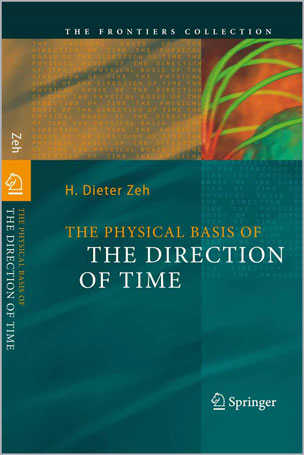
Four previous editions of this book were published in 1989, 1992, 1999, and 2001. They were preceded by a German version (Zeh 1984) that was based on lectures I had given at the University of Heidelberg. My interest in this subject arose originally from the endeavor to better understand all aspects of irreversibility that might be relevant for the statistical nature and interpretation of quantum theory.
This thoroughly revised 5th edition of Zeh's classic text investigates irreversible phenomena and their foundation in classical, quantum and cosmological settings. It includes new sections on the meaning of probabilities in a cosmological context, irreversible aspects of quantum computers, and various consequences of the expansion of the Universe. Many other sections have been rewritten. In particular, the book contains an analysis of the physical concept of time, a detailed treatment of radiation damping as well as extended sections on quantum entanglement and decoherence, arrows of time hidden in various interpretations of quantum theory, and the emergence of time in quantum gravity. Both physicists and philosophers of science will find in this book a magnificent survey and a concise, technically sophisticated, up-to-date discussion which shows fine sensitivity to crucial conceptual subtleties.
Table of Contents
1 The Physical Concept of Time
2 The Time Arrow of Radiation
3 The Thermodynamical Arrow of Time
4 The Quantum Mechanical Arrow of Time
5 The Time Arrow of Spacetime Geometry
6 The Time Arrow in Quantum Cosmology
H. Dieter Zeh studied physics in Brunswick and Heidelberg, where he began work on theoretical nuclear physics. After a year of research at the California Institute of Technology, he moved to the University of California in San Diego to work on the synthesis of the heavy elements, before returning to the University of Heidelberg, where he later became professor of theoretical physics. His studies of collective motion in nuclei led him to address the quantum-to-classical transition in general, and in particular the quantum measurement problem, which is in turn related to many aspects of irreversibility (arrows of time). During this work, Zeh recognized and formulated the universal and unavoidable role of uncontrollable quantum entanglement, thus becoming a founder of the area now known as decoherence.