ثبت نام / ورود
0
ثبت نام / ورود
0
Olival Freire Jr
#History
#Quantum
#Einstein
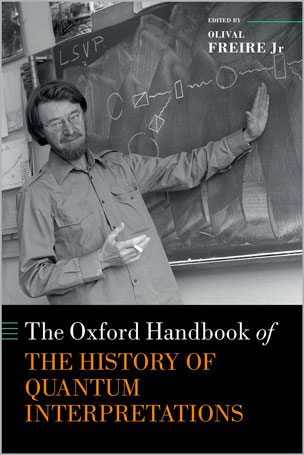
Crucial to most research in physics, as well as leading to the development of inventions such as the transistor and the laser, quantum mechanics approaches its centenary with an impressive record. However, the field has also long been the subject of ongoing debates about the foundations and interpretation of the theory, referred to as the quantum controversy.
This Oxford Handbook offers a historical overview of the contrasts which have been at the heart of quantum physics for the last 100 years. Drawing on the wide-ranging expertise of several contributors working across physics, history, and philosophy, the handbook outlines the main theories and interpretations of quantum physics. It goes on to tackle the key controversies surrounding the field, touching on issues such as determinism, realism, locality, classicality, information, measurements, mathematical foundations, and the links between quantum theory and gravity.
This engaging introduction is an essential guide for all those interested in the history of scientific controversies and history of quantum physics. It also provides a fascinating examination of the potential of quantum physics to influence new discoveries and advances in fields such quantum information and computing.
Table of Contents
PART I: QUANTUM PHYSICS-SCIENTIFIC AND PHILOSOPHICAL ISSUES UNDER DEBATE
1. Quantum Mechanics is Routinely Used in Laboratories with Great Success, but No Consensus on its Interpretation has Emerged• Franck Laloe
2. Philosophical Issues Raised by Quantum Theory and its Interpretations • Wayne C. MyNold
PART II: HISTORICAL LANDMARKS OF THE INTERPRETATIONS AND FOUNDATIONS OF QUANTUM PHYSICS
3. Quantization Conditions, 1900- 1927 • Anthony Duncan and Michel Janssen
4. Of Weighting and Counting: Statistics and Ontology in the Old Quantum Theory • Massimiliano Badino
5. Dead as a Doornail? Zero-Point Energy and Low-Temperature Physics in Early Quantum Theory• Helge Kragh
6. The Early Debates about the Interpretation of Quantum Mechanics • Martin Jahnert and Christoph Lehner
7. Foundations and Applications: The Creative Tension in the Early Development of Quantum Mechanics • Christian Joas
8. The Statistical Interpretation: Born, Heisenberg, and von Neumann, 1926-27 • Guido Bacciagaluppi
9. A Perennially Grinning Cheshire Cat? Over A Century of Experiments on Light Quanta and Their Perplexing Interpretations • Klaus Hentschel
10. The Evolving Understanding of Quantum Statistics • Daniela Monaldi
11. The Measurement Problem • Osvaldo Pessoa Jr.
12. Einstein's Criticism of Quantum Mechanics • Michel Paty
13. Tackling Loopholes in Experimental Tests of Bell's Inequality • David I. Kaiser
14. The Measuring Process in Quantum Field Theory • Thiago Hartz
14. The Measuring Process in Quantum Field Theory • Thiago Hartz
15. The Interpretation Debate and Quantum Gravity• Alexander S. Blum and Bernadette Lessel
16. Quantum Information and the Quest for Reconstruction of Quantum Theory • Alexei Grinbaum
17. Natural Reconstructions of Quantum Mechanics • Olivier Darrigo!
18. The Axiomatization of Quantum Theory through Functional Analysis: Hilbert, von Neumann, and Beyond • Klaas Landsman
19. Tony Leggett's Challenge to Quantum Mechanics and its Pathto Decoherence • Fabio Freitas
PART Ill: PLACES AND CONTEXTS RELEVANT FOR THE INTERPRETATIONS OF QUANTUM THEORY
20. The Copenhagen Interpretation• Don Howard
21. Copenhagen and Niels Bohr • Anja Skaar Jacobsen
22. Grete Hermann's Interpretation of Quantum Mechanics • Elise Crull
23. Instrumentation and the Foundations of Quantum Mechanics • Climerio Paulo da Silva Neto
24. Early Solvay Councils: Rhetorical Lenses for Quantum Convergence and Divergence • Jose G. Perillan
25. The Foundations of Quantum Mechanics in Post-Warltaly's Cultural Context • Flavio Del Santo
26. Foundations of Quantum Physics in the Soviet Union • Jean-Philippe Martinez
27. Early Japanese Reactions to the Interpretation of Quantum Mechanics, 1927- 1943 • Kenji Ito
28. Form and Meaning: Textbooks, Pedagogy, and the Canonical Genres of Quantum Mechanics • Josep Simon
29. Chien-Shiung Wu's Contributions to Experimental Philosophy • lndianara Silva
30. On How Epistemological Letters Changed the Foundations of Quantum Mechanics • Sebastian Murgueitio Ramfrez
31. Quantum Interpretations and 20th Century Philosophy of Science • Thomas Ryckman
PART IV: HISTORICAL AND PHILOSOPHICAL THESES
32. Bohr and the Epistemological Lesson of Quantum Mechanics • Stefano Osnaghi
33. Making Sense of the Century-Old Scientific Controversy over the Quanta • Oliva! Freire Jr.
34. Orthodoxy and Heterodoxy in the Post-war Era • Kristian Camilleri
35. The Reception of the Forman Thesis in Modernity and Postmodernity • Paul Forman
36. Quantum Historiography and Cultural History: Revisiting the Forman Thesis • Alexei Kojevnikov
37. The Co-creation of Classical and Modern Physics and the Foundations of Quantum Mechanics • Richard Staley
38. Interpretation in Electrodynamics. Atomic Theory, and Quantum Mechanics • Giora Hon and Bernard R. Goldstein
PART V: THE PROLIFERATION OF INTERPRETATIONS
39. Hidden Variables • Jeffrey Bub
40. Pure Wave Mechanics, Relative States, and Many Worlds • Jeffrey A. Barrett
41. Is QBism a Possible Solution to the Conceptual Problems of Quantum Mechanics?• HeNe Zwirn
42. Agential Realism-A Relation Ontology Interpretation of Quantum Physics • Karen Barad
43. The Relational Interpretation • Carlo Rovelli
44. The Philosophy of Wholeness and the General and New Concept of Order: Bohm's and Penrose's Points of View• Jean-Jacques Szczeciniarz and Joseph Kouneiher
45. Spontaneous Localization Theories: Quantum Philosophy between History and Physics • Valia Allori
46. The Non-Individuals Interpretation of Quantum Mechanics • Decio Krause, Jonas R. B. Arenhart, and Otavio Bueno
47. Modal Interpretations of Quantum Mechanics• Dennis Dieks
48. A Brief Historical Perspective on the Consistent Histories Interpretation of Quantum Mechanics • Gustavo Rocha, Dean Rickles, and Florian Boge
49. Einstein, Bohm, and Bell: A Comedy of Errors • Jean Bricmont
50. The Statistical (Ensemble) Interpretation of Quantum Mechanics • Alexander Pechenkin
51. Stochastic Interpretations of Quantum Mechanics• Emilio Santos
"It emphasizes the strange nature of quantum theory, which is remarkably productive despite seeming unstable and fractured. Its mysteries are clearly not going to be resolved in the near future, which makes this handbook a launching point for future work rather than a summary of past efforts." -- Matthew Stanley, Physics Today"
One of the many interesting themes that emerge across the volume is how it prompts the reader not only to question the orthodox understanding of quantum mechanics― namely, the Copenhagen interpretation― but to question the very idea that there ever was such a quantum orthodoxy." -- Matthew Stanley, New York University in Physics Today"
Quantum mechanics is the basis for contemporary physics and our guide to technologies from the transistor to quantum computing, yet a century after its codification in 1926, debates rage over its physical meaning. The editors of this grand volume have assembled remarkable essays about the history and state of this theory like no other. Bravo! Physicists, historians and philosophers will plumb the riches here for decades." -- Peter Galison, Director, Black Hole Initiative, Harvard University
Olival Freire Jr is Professor of Physics and History of Science at the Universidade Federal da Bahia, Brazil. He is the author of The Quantum Dissidents (2015) and David Bohm: A Life Dedicated to Understanding the Quantum World (2019). In 2011 he co-edited Teoria quântica: estudos históricos e implicações culturais with Osvaldo Pessoa Jr. and Joan Lisa Bromberg and was awarded the Jabuti Prize in Science & Technology, the most important literary prize in Brazil.