ثبت نام / ورود
0
ثبت نام / ورود
0
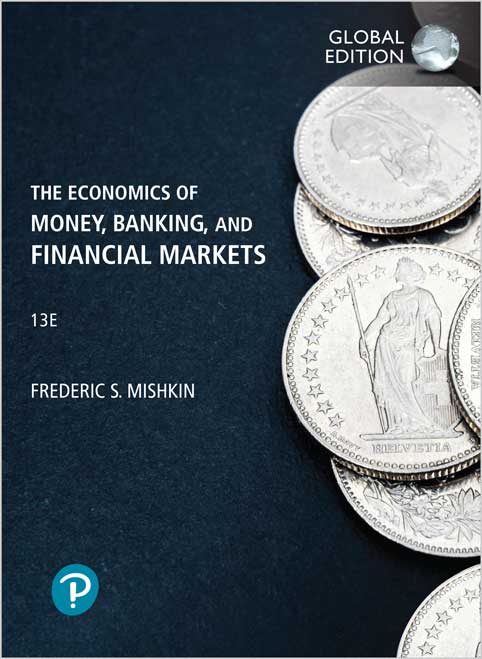
Frederic S. Mishkin
#Economics
#Financial
#Markets
#Money
#Banking
#Finance
#Policy
For courses in money and banking, or general economics.
A unified framework for understanding financial markets
The Economics of Money, Banking and Financial Markets brings a fresh perspective to today’s major questions surrounding financial policy. Influenced by his term as Governor of the Federal Reserve, Frederic Mishkinoffers students a unique viewpoint and informed insight into the monetary policy process, the regulation and supervision of the financial system, and the internationalization of financial markets.
The 13th Edition provides unifying, analytical framework for learning that fits a wide variety of syllabi. And core economic principles and real-world examples organize students' thinking and keep them motivated. After reading this text, students are well equipped to apply these financial models, terms, and equations to decisions that affect both their personal and professional lives.
Table of Contents:
PART 1-Introduction
1-Why Study Money, Banking, and Financial Markets
2-An Overview of the Financial System
3-What ls Money
PART 2-Financial Markets
4-The Meaning of interest Rates
5-The Behavior of Interest Rates
6 The Risk and Term Structure of interest Rates
7-he Stock Market, the Theory of Rational Expectations, and the Efficient Market Hypothesis
PART 3-Financial Institutions
8-An Economic Analysis of Financial Structure
9-Banking and the Management of Financial Institutions
10-Economic Analysis of Financial Regulation
11-Banking Industry. Structure and Competition
12-Financial Crises in Advanced Economies
13-Financial Crises in Emerging Market Economies
PART 4-Central Banking and the Conduct of Monetary Policy
14-central bans
15-The Money Supply Process
16-Tools of Monetary Policy
17-The Conduct of Monetary Policy. Strategy and Tactics
PART 5-International Finance and Monetary Policy
18-The Foreign Exchange Market
19-The international Financial System
PART 6-Monetary Theory
20-Quantity Theory, Inflation, and the Demand for Money
21-The lS Curve
22-The Monetary Policy and Aggregate Demand Curves
23-Aggregate Demand and Supply Analysis
24-Monetary Policy Theory
25-The Role of Expectations in Monetary Policy
26-Transmission Mechanisms of Monetary Policy
About the Author
Frederic S. Mishkin is the Alfred Lerner Professor of Banking and Financial Institutions at the Graduate School of Business, Columbia University. He is also a Research Associate at the National Bureau of Economic Research, co-director of the U.S. Monetary Policy Forum, a member of the Squam Lake Working Group on Financial Reform, and past president of the Eastern Economics Association. Since receiving his Ph.D. from the Massachusetts Institute of Technology in 1976, he has taught at the University of Chicago, Northwestern University, Princeton University, and Columbia. He has also received an honorary professorship from the People’s (Renmin) University of China. From 1994 to 1997, he was Executive Vice President and Director of Research at the Federal Reserve Bank of New York and an associate economist of the Federal Open Market Committee of the Federal Reserve System. From September 2006 to August 2008, he was a member (governor) of the Board of Governors of the Federal Reserve System.
Professor Mishkin’s research focuses on monetary policy and its impact on financial markets and the aggregate economy. He is the author of more than twenty books, including Macroeconomics: Policy and Practice, Second Edition (Pearson, 2015); Financial Markets and Institutions, Ninth Edition (Pearson, 2018); Monetary Policy Strategy (MIT Press, 2007); The Next Great Globalization: How Disadvantaged Nations Can Harness Their Financial Systems to Get Rich (Princeton University Press, 2006); Inflation Targeting: Lessons from the International Experience (Princeton University Press, 1999); Money, Interest Rates, and Inflation (Edward Elgar, 1993); and A Rational Expectations Approach to Macroeconometrics: Testing Policy Ineffectiveness and Efficient Markets Models (University of Chicago Press, 1983). In addition, he has published more than 200 articles in such journals as American Economic Review, Journal of Political Economy, Econometrica, Quarterly Journal of Economics, Journal of Finance, and Journal of Monetary Economics.
Professor Mishkin has served on the editorial board of American Economic Review and has been an associate editor at Journal of Business and Economic Statistics, Journal of Applied Econometrics, Journal of Economic Perspectives, Journal of International Money and Finance, and Journal of Money, Credit and Banking; he also served as the editor of the Federal Reserve Bank of New York’s Economic Policy Review. He is currently an associate editor (member of the editorial board) at six academic journals, including International Finance; Finance India; Review of Development Finance; Borsa Economic Review; PSU Research Review and Emerging Markets; and Finance and Trade. He has been a consultant to the Board of Governors of the Federal Reserve System, the World Bank, and the International Monetary Fund, as well as to many central banks throughout the world. He was also a member of the International Advisory Board to the Financial Supervisory Service of South Korea and an advisor to the Institute for Monetary and Economic Research at the Bank of Korea. Professor Mishkin was a Senior Fellow at the Federal Deposit Insurance Corporation’s Center for Banking Research and was an academic consultant to and serves on the Economic Advisory Panel and Monetary Advisory Panel of the Federal Reserve Bank of New York.