ثبت نام / ورود
0
ثبت نام / ورود
0
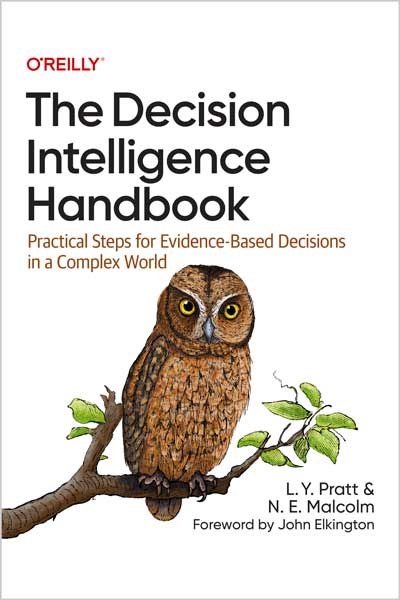
Practical Steps for Evidence-Based Decisions in a Complex World
L. Y. Pratt, N. E. Malcolm
#Decision_Intelligence
#DI
#AI
#CDD
Decision intelligence (DI) has been widely named as a top technology trend for several years, and Gartner reports that more than a third of large organizations are adopting it. Some even say that DI is the next step in the evolution of AI. Many software vendors offer DI solutions today, as they help organizations implement their evidence-based or data-driven decision strategies.
But until now, there has been little practical guidance for organizations to formalize decision making and integrate their decisions with data.
With this book, authors L. Y. Pratt and N. E. Malcolm fill this gap. They present a step-by-step method for integrating technology into decisions that bridge from actions to desired outcomes, with a focus on systems that act in an advisory, human-in-the-loop capacity to decision makers.
This handbook addresses three widespread data-driven decision-making problems:
Table of Contents
Chapter 1. Introduction
Chapter 2. Decision Requirements
Chapter 3. Decision Modeling: The Decision Design Process
Chapter 4. Decision Modeling: The Decision Asset Investigation Process
Chapter 5. Decision Reasoning: The Decision Simulation Process
Chapter 6. Decision Reasoning: The Decision Assessment Process
Chapter 7. Decision Action
Chapter 8. Decision Review
About This Book
This book is a practical, “roll up your sleeves” guide to how you can do DI, within your own organization or as a consultant or Decision Intelligence Service Provider (DISP) or Decision Intelligence Infrastructure Provider (DIIP) for others. It’s organized around a collection of nine DI “best practice” processes. We’ll walk you through each one, starting with how to decide if DI is right for your situation. We’ll show you how to go about designing a decision. By the time you work through the book, you’ll have a continuously improvable decision asset that is connected to data, AI, and more in a way that will drive competitive differentiation and success through better decision making.
But before we dive into the gnarly details, we feel it’s important for you to understand that you can start doing DI today. Seriously, we’re talking about 20 minutes from now: the time that it takes to get to the section called “Build Your First CDD, Right Now!” in the next chapter.
Who Is This Book For?
This book is for you if you’d like to learn how to introduce DI to your organization or to your clients. You might be an executive who takes decisions seriously, combining the best of diverse human and computer knowledge to drive competitive advantage. You might be passionate about addressing climate change, but you know that there’s a lot of earth observation (EO) data that’s going unused because data scientists don’t know how to connect it to decision making. You might be a data or AI consultant or an employee in one of the emerging DISP companies, looking to differentiate your practice by providing something new and valuable. You might be an ML expert who wants to maximize the value of this important technology, or a head of analytics or business intelligence who needs a way to communicate with your internal clients so that your technology helps them with better evidence-based decisions.
We’ve written this book for the “insurgent” bottom-up perspective, as well as for the lucky few who have obtained centralized executive sponsorship to take DI organization-wide. Indeed, we wrote this book in collaboration with a G20 central bank in the process of doing just that, and the bank has adapted this book for its internal use.
What You Will Learn
After completing this book, you will:
And you’ll understand how to use DI to:
Please note that there are several topics that are not covered here. For instance, we don’t delve into the broader societal impacts of DI or its potential for solving complex problems like the climate and pandemics. These impacts are covered in Link. Finally, we don’t get into the technical specifics of how to build DI tools such APIs, interfaces, or AI and statistical models that interoperate with computerized DI models. Those technologies change quickly, but the principles we offer here stand on their own, independent of specific technological choices.