ثبت نام / ورود
0
ثبت نام / ورود
0
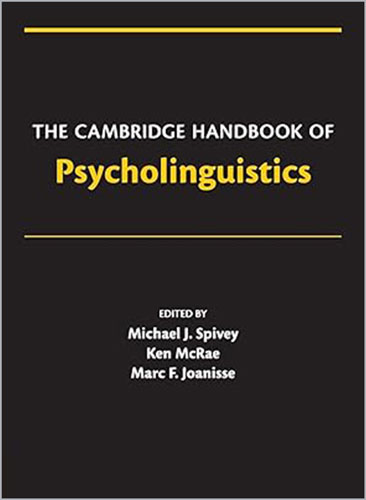
Michael Spivey, Marc Joanisse, Ken McRae
#Psycholinguistics
#Cognitive_science
#Phonology
Our ability to speak, write, understand speech and read is critical to our ability to function in today's society. As such, psycholinguistics, or the study of how humans learn and use language, is a central topic in cognitive science. This comprehensive handbook is a collection of chapters written not by practitioners in the field, who can summarize the work going on around them, but by trailblazers from a wide array of subfields, who have been shaping the field of psycholinguistics over the last decade. Some topics discussed include how children learn language, how average adults understand and produce language, how language is represented in the brain, how brain-damaged individuals perform in terms of their language abilities and computer-based models of language and meaning. This is required reading for advanced researchers, graduate students and upper-level undergraduates who are interested in the recent developments and the future of psycholinguistics.
Table of Contents
Section 1 SPEECH PERCEPTION
CHAPTER 1 Speech Perception
CHAPTER 2 Neural Bases of Speech Perception - Phonology, Streams, and Auditory Word Forms
CHAPTER 3 Learning the Sounds of Language
Section 2 SPOKEN WORD RECOGNITION
CHAPTER 4 Current Directions in Research in Spoken Word Recognition
CHAPTER 5 Computational Models of Spoken Word Recognition
CHAPTER 6 Finding the Words: How Young Children Develop Skill in Interpreting Spoken Language
CHAPTER 7 Event -Related Potentials and Magnetic Fields Associated with Spoken Word Recognition
Section 3 WRITTEN WORD RECOGNITION
CHAPTER 8 Visual Word Recognition in Skilled Adult Readers
CHAPTER 9 Computational Models of Reading: Connectionist and Dual-Route Approaches
CHAPTER 10 Decoding, Orthographic Learning, and the Development of Visual Word Recognition
CHAPTER 11 How Does the Brain Read Words?
Section 4 SEMANTIC MEMORY
CHAPTER 12 The Human Conceptual System
CHAPTER 13 Computational Models of Semantic Memory
CHAPTER 14 Developing Categories and Concepts
Section 5 MORPHOLOGICAL PROCESSING
CHAPTER 15 Derivational Morphology and Skilled Reading: An Empirical Overview
CHAPTER 16 The Neural Basis of Morphology: A Tale of Two Mechanisms?
Section 6 SENTENCE COMPREHENSION
CHAPTER 17 Individual Differences in Sentence Processing
CHAPTER 18 The Neurobiology of Sentence Comprehension
CHAPTER 19 Computational and Corpus Models of Human Sentence Comprehension
Section 7 SENTENCE PRODUCTION
CHAPTER 20 Research in Language Production
CHAPTER 21 Language Production: Computat ional Models
CHAPTER 22 Language Production: Patient and Imaging Research
Section 8 FIGURATIVE LANGUAGE
CHAPTER 23 Figurative Language: Normal Adult Cognitive Research
CHAPTER 24 Computat ional Approaches to Figurat ive Language
CHAPTER 25 The Development of Figurat ive Language
CHAPTER 26 Cognitive Neuroscience of Figurative Language
Section 9 DISCOURSE AND CONVERSATION
CHAPTER 27 Spoken Discourse and Its Emergence
Michael J. Spivey was on the faculty of Cornell University for twelve years before moving to the Cognitive and Information Sciences unit at the University of California, Merced in 2008. His research uses dense-sampling methods (such as eye tracking and reach tracking) to explore the real-time interaction between language and vision. He has published in a variety of top-tier journals, including Science, Cognitive Science, Trends in Cognitive Sciences, Psychological Science and Proceedings of the National Academy of Sciences. Spivey is the recipient of Sigma Xi's William Procter Prize for Scientific Achievement and multiple teaching awards from Cornell University. The dynamical cognition framework that guides his research is described in his book The Continuity of Mind (2007).
Marc F. Joanisse has been at the University of Western Ontario since 2000, studying the cognitive and brain bases of spoken and written language. Work in his laboratory emphasizes the importance of studying multiple aspects of language ability, in a variety of populations, using a range of techniques. His research spans a range of topics encompassing speech perception, spoken word recognition and reading and grammar abilities in adults and children, using everything from traditional behavioral techniques to eye tracking, event-related potentials and fMRI. In addition, he has published articles in the field of connectionist modeling of language processing, aphasia following brain injury and language disorders in children. He has published in a wide range of journals, including the Proceedings of the National Academy of Sciences, the Journal of Cognitive Neuroscience, Cerebral Cortex, NeuroImage, the Journal of Memory and Language and the Journal of Experimental Psychology: Learning Memory and Cognition.
Ken McRae has been at the University of Western Ontario since 1993, where he has been studying language and concepts. He has published articles regarding sentence processing and semantic memory from numerous perspectives, including modality-specific representations, the roles of statistical correlations and causal relations in object concepts, category-specific semantic deficits and the integration of meaning and structure in sentence comprehension. He has also published a number of computational models of these important human abilities. McRae has published in journals such as Cognition, the Journal of Memory and Language, the Journal of Experimental Psychology, Cognitive Science and Neuropsychologia.