ثبت نام / ورود
0
ثبت نام / ورود
0
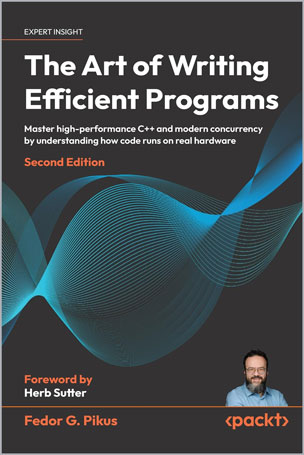
Master high-performance C++ and modern concurrency by understanding how code runs on real hardware
Fedor G. Pikus
#C++
#CPU
#Hardware
Gain practical skills to optimize C++ programs using modern CPU architectures, memory models, and concurrency tools
Key Features
Book Description
Hardware stopped making your programs faster for free a long time ago. What it does instead is reward code that understands it, code written with a clear picture of how the CPU executes instructions, how memory really moves through caches, and what the compiler can and cannot do on your behalf. This book teaches that understanding, from first principles to the most advanced techniques, and shows you how to turn it into measurably faster software.
This edition is roughly half new and >60% longer. The coverage of CPU architecture (now including ARM), instruction processing, and the memory hierarchy, from caches to paging and virtual addressing, is expanded throughout. But the largest change is concurrency, which now makes up nearly half the book and is entirely rewritten: the memory model, atomic operations and atomic shared pointers, coroutine-based execution, NUMA-aware design, and a completely rewritten chapter on concurrent data structures that shows how cache coherency on modern hardware changes the established rules of lock-free programming, including advanced techniques such as helping.
Written by Fedor G. Pikus, industry leader in high-performance C++, with a foreword by Herb Sutter, this book equips you with both conceptual clarity and the hands-on techniques needed to make your software faster, leaner, and smarter.
What you will learn
Who this book is for
Experienced C++ developers, performance-focused programmers, and engineers working in high-speed systems like trading platforms, games, or scientific computing. Prior knowledge of multithreading and memory management is required to make the most of this book.
Table of Contents
About the Author
Fedor G. Pikus is a chief engineering scientist in the Mentor IC Segment of Siemens Digital Industries Software and is responsible for the long-term technical direction of Calibre products, the design and architecture of software, and research into new software technologies. His previous roles included senior software engineer at Google and chief software architect at Mentor Graphics. Fedor is a recognized expert in high-performance computing and C++. He has presented his works at CPPCon, SD West, DesignCon, and in software development journals, and is also an O'Reilly author. Fedor has over 25 patents and over 100 papers and conference presentations on physics, EDA, software design, and C++.
Fedor G. Pikus is a chief engineering scientist in the Mentor IC Segment of Siemens Digital Industries Software and is responsible for the long-term technical direction of Calibre products, the design and architecture of software, and research into new software technologies. His previous roles included senior software engineer at Google and chief software architect at Mentor Graphics. Fedor is a recognized expert in high-performance computing and C++. He has presented his works at CPPCon, SD West, DesignCon, and in software development journals, and is also an O'Reilly author. Fedor has over 25 patents and over 100 papers and conference presentations on physics, EDA, software design, and C++.