ثبت نام / ورود
0
ثبت نام / ورود
0
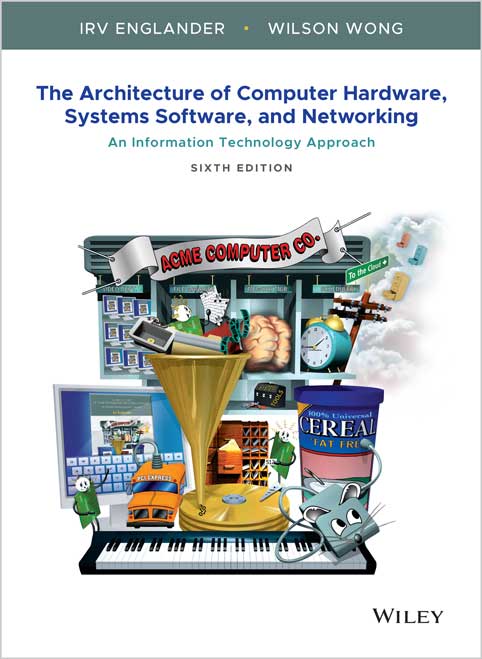
An Information Technology Approach
Irv Englander, Wilson Wong
#Hardware
#Software
#Networking
#CPU
#TCP/IP
#Data
#Operating_System
The Architecture of Computer Hardware, Systems Software and Networking is designed help students majoring in information technology (IT) and information systems (IS) understand the structure and operation of computers and computer-based devices. Requiring only basic computer skills, this accessible textbook introduces the basic principles of system architecture and explores current technological practices and trends using clear, easy-to-understand language. Throughout the text, numerous relatable examples, subject-specific illustrations, and in-depth case studies reinforce key learning points and show students how important concepts are applied in the real world.
This fully-updated sixth edition features a wealth of new and revised content that reflects today’s technological landscape. Organized into five parts, the book first explains the role of the computer in information systems and provides an overview of its components. Subsequent sections discuss the representation of data in the computer, hardware architecture and operational concepts, the basics of computer networking, system software and operating systems, and various interconnected systems and components. Students are introduced to the material using ideas already familiar to them, allowing them to gradually build upon what they have learned without being overwhelmed and develop a deeper knowledge of computer architecture.
Part I An Overview of Computer Systems
Chapter 1 Computers and Systems
Chapter 2 An Introduction to System Concepts and Systems Architecture
Part II Data in the Computer
Chapter 3 Number Systems
Chapter 4 Data Formats
Chapter 5 Representing Numerical Data
Part III Computer Architecture and Hardware Operation
Chapter 6 The Little Man Computer
Chapter 7 The CPU and Memory
Chapter 8 CPU and Memory: Design, Enhancement, and Implementation
Chapter 9 Input/Output and Buses
Chapter 10 Computer Peripherals
Chapter 11 Computer System Organization
Part IV Networks, Data Communications, and Networked Computer Systems
Chapter 12 Networks and Data Communications-An Overview
Chapter 13 Ethernet and TCP/IP Networking
Chapter 14 Communication Channel Technology
Chapter 15 Modern Networked Computer Systems
Part V The Software Component
Chapter 16 Operating Systems: An Overview
Chapter 17 The User View of Operating Systems
Chapter 18 File Management
Chapter 19 The Internal Operating System
About the Author
Dr. Irv Englander has been involved in many different aspects of the computing field for more than sixty years. He has designed logic circuits, developed integrated circuits, developed computer architectures, designed computer-controlled systems, designed operating systems, developed application software, created the initial system design for a large watermonitoring system, performed software auditing and verification of critical control software, and developed and specified hardware components and application software as a consultant for business systems large and small. As an educator, he has contributed papers and given workshops on end-user computing, e-commerce, and on various aspects of IS and IT pedagogy. He was an invited contributor and reviewer for the IS-97 and IS-2002 information systems curricula, and continues to publish and take an interest in the technical infrastructure components of the IS/IT curriculum. He is actively involved in the application of new technology to information systems. Most recently he served as a faculty advisor to a low-cost supercomputing student research project, which was presented at the ACM/IEEE Computer Society Supercomputing Conference SC13. Dr. Englander has a Ph.D. from MIT in Computer Science. His doctoral thesis was based on the design of a large image-processing software laboratory. At MIT, he won the Supervised Investors Award for outstanding teaching. He holds the rank of Professor Emeritus of Computer Information Systems at Bentley University, where he taught full-time for thirtyeight years.
Dr. Wilson Wong likes the fact that he was born in 1965, the same year the IBM 360 mainframe computer made its first appearance. Graduating with a B.S. from MIT in Computer Science and Engineering and an M.B.A. from Cornell University, he spent the first twenty years of his career as a software developer, a director of IT departments, and Chief Technologist at companies and startups in various industries, including publishing, law, Web development, technology, and early e-commerce. Dr. Wong entered academia in 2001; he spent 14 years at Bentley University in the Computer Information Systems department, teaching a wide variety of courses including computer architecture, database, software project design and management, and Web development. Although it was not in his original plans, he also earned a Ph.D. in Business with a concentration in Information Systems from Bentley along the way. As an educator, he has presented papers on IS pedagogy, particularly in IS capstone project innovations, and serves regularly as a reviewer for various IS journals and conferences. Dr. Wong is currently an Assistant Teaching Professor of Computer Science at Worcester Polytechnic Institute where he enjoys teaching databases and a software engineering course that includes collaborative projects with industry and the federal government. He is also the CS Faculty Advisor to the WPI Fintech Project Center, where he manages technical senior projects in collaboration with various Wall Street and International banking firms.