ثبت نام / ورود
0
ثبت نام / ورود
0
Roland E. Thomas, Albert J. Rosa, Gregory J. Toussaint
#Linear_Circuits
#OP
#AMP
#Electrical_Engineering
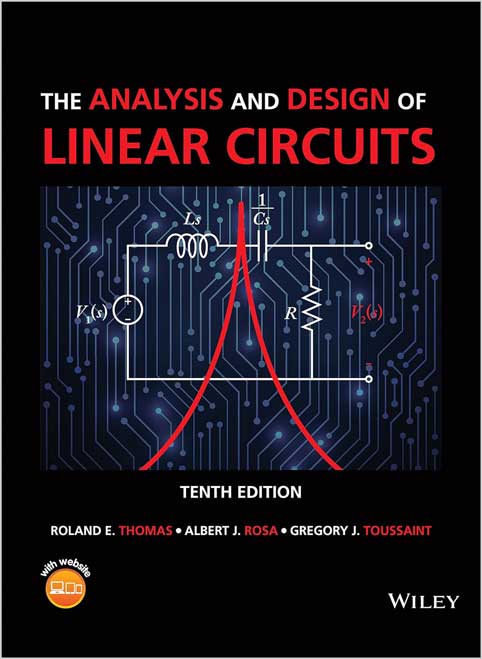
The Analysis and Design of Linear Circuits, 10th Edition, taps into engineering students desire to explore, create, and put their learning into practice by presenting linear circuit theory, with an emphasis on circuit analysis and how to evaluate competing designs. The text integrates active and passive linear circuits, allowing students to understand and design a wide range of circuits, solve analytical problems, and devise solutions to problems.
The authors use both phasors and Laplace techniques for AC circuits, enabling better understanding of frequency response, filters, AC power, and transformers. The authors have increased the integration of MATLAB® and Multisim in the text and revised content to be up-to-date with technology when appropriate. The text uses a structured pedagogy where objectives are stated in each chapter opener and examples and exercises are developed so that the students achieve mastery of each objective. The available problems revisit each objective and a suite of problems of increasing complexity task the students to check their understanding.
Topics covered in The Analysis and Design of Linear Circuits, 10th Edition, include:
With an overarching goal of instilling smart judgment surrounding design problems and innovative solutions, The Analysis and Design of Linear Circuits, 10th Edition, provides inspiration and motivation alongside an essential knowledge base. The text is designed for two semesters and is complemented with robust supplementary material to enhance various pedagogical approaches, including an Instructors Manual which features an update on how to use the book to complement the 2022-23 ABET accreditation criteria, 73 lesson outlines using the new edition, additional Instructor Problems, and a Solutions Manual.
Table of Contents
CHAPTER 1 • INTRODUCTION
CHAPTER 2 • BASIC CIRCUIT ANALYSIS
CHAPTER 3 • CIRCUIT ANALYSIS TECHNIQUES
CHAPTER 4 • ACTIVE CIRCUITS
CHAPTER 5 • SIGNAL WAVEFORMS
CHAPTER 6 • CAPACITANCE AND INDUCTANCE
CHAPTER 7 • FIRST- AND SECOND-ORDER CIRCUITS
CHAPTER 8 • SINUSOIDAL STEADY-STATE RESPONSE
CHAPTER 9 • LAPLACE TRANSFORMS
CHAPTER 10 • s-DOMAIN CIRCUIT ANALYSIS
CHAPTER 11 • NETWORK FUNCTIONS
CHAPTER 12 • FREQUENCY RESPONSE
CHAPTER 13 • FOURIER SERIES
CHAPTER 14 • ACTIVE FILTER DESIGN
CHAPTER 15 • MUTUAL INDUCTANCE AND TRANSFORMERS
CHAPTER 16 • AC POWER SYSTEMS
CHAPTER 17 • TWO-PORT NETWORKS
CHAPTER 18 • FOURIER TRANSFORMS
APPENDIX A SOLUTION OF LINE ARE QUATIONS
APPENDIX B BUTTER WORTH AND CHEBYSHEV POLES
APPENDIX C BEHAVIORALLY MOTIVATED LEARNING
APPENDIX D COMPUTATIONAL TOOLS
APPENDIX F COMPLEX NUMBERS
APPENDIX G STANDARD VALUES AND REFERENCES
APPENDIX H ANSWERS TO SELECTED PROBLEMS
Dr. Roland E. Thomas was the visionary behind this text. He pioneered the use of OP AMPs in basic circuits, the early use of Laplace for analyzing AC circuits, and the use of competing filter realizations to help students achieve optimum designs. His integration of Bloom’s Taxonomy was a novel and valued approach for ensuring students attain competence in various topics. Ron passed away in 2019, but his vision continues in this edition.
Dr. Albert J. Rosa has 44 years of experience in practicing engineering, education and teaching, with nine years spent at the US Air Force Academy in the Electrical Engineering Department finishing as Professor and Head, and an additional eight years as Distinguished Visiting Professor and Erdle Fellow, and 17 years as Chair of the Engineering Department at the University of Denver, USA. He served 25 years as an ABET program evaluator for IEEE and ASEE.
Dr. Gregory J. Toussaint has 33 years of experience as a practicing engineer, including seven years teaching electrical engineering at the US Air Force Academy in the Electrical Engineering Department and at the graduate level at the Air Force Institute of Technology, Department of Electrical and Computer Engineering.