ثبت نام / ورود
0
ثبت نام / ورود
0
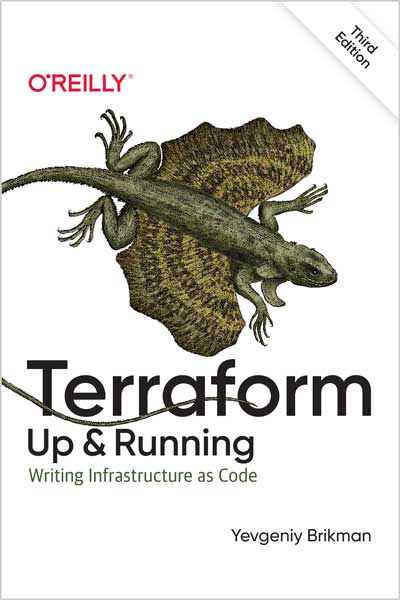
Writing Infrastructure as Code
Yevgeniy Brikman
#Terraform
#Up
#and
#Running
#AWS
#DevOps
#IaC
#Cloud
#Azure
#CloudFormation
#Pulumi
#Puppet
Terraform has become a key player in the DevOps world for defining, launching, and managing infrastructure as code (IaC) across a variety of cloud and virtualization platforms, including AWS, Google Cloud, Azure, and more. This hands-on third edition, expanded and thoroughly updated for version 1.0 and beyond, shows you the fastest way to get up and running with Terraform.
Gruntwork cofounder Yevgeniy (Jim) Brikman takes you through code examples that demonstrate Terraform's simple, declarative programming language for deploying and managing infrastructure with a few commands. Veteran sysadmins, DevOps engineers, and novice developers will quickly go from Terraform basics to running a full stack that can support a massive amount of traffic and a large team of developers.
Who Should Read This Book
This book is for anyone responsible for the code after it has been written. That includes sysadmins, operations engineers, release engineers, site reliability engineers, DevOps engineers, infrastructure developers, full-stack developers, engineering managers, and CTOs. No matter what your title is, if you’re the one managing infrastructure, deploying code, configuring servers, scaling clusters, backing up data, monitoring apps, and responding to alerts at 3 a.m., this book is for you.
Collectively, all of these tasks are usually referred to as operations. In the past, it was common to find developers who knew how to write code but did not understand operations; likewise, it was common to find sysadmins who understood operations but did not know how to write code. You could get away with that divide in the past, but in the modern world, as cloud computing and the DevOps movement become ubiquitous, just about every developer will need to learn operational skills, and every sysadmin will need to learn coding skills.
This book does not assume that you’re already an expert coder or expert sysadmin—a basic familiarity with programming, the command line, and server-based software (e.g., websites) should suffice. Everything else you need you’ll be able to pick up as you go, so that by the end of the book, you will have a solid grasp of one of the most critical aspects of modern development and operations: managing infrastructure as code.
In fact, you’ll learn not only how to manage infrastructure as code using Terraform but also how this fits into the overall DevOps world. Here are some of the questions you’ll be able to answer by the end of the book:
The only tools you need are a computer (Terraform runs on most operating systems), an internet connection, and the desire to learn.
What You Won’t Find in This Book
This book is not meant to be an exhaustive reference manual for Terraform. I do not cover all of the cloud providers, or all of the resources supported by each cloud provider, or every available Terraform command. For these nitty-gritty details, I refer you instead to the Terraform documentation.
The documentation contains many useful answers, but if you’re new to Terraform, infrastructure as code, or operations, you won’t even know what questions to ask. Therefore, this book is focused on what the documentation does not cover: namely, how to go beyond introductory examples and use Terraform in a real-world setting. My goal is to get you up and running quickly by discussing why you might want to use Terraform in the first place, how to fit it into your workflow, and what practices and patterns tend to work best.
To demonstrate these patterns, I’ve included a number of code examples. I’ve tried to make it as easy as possible for you to try these examples at home by minimizing dependencies on any third parties. This is why almost all the examples use just a single cloud provider, AWS, so that you need to sign up only for a single third-party service (also, AWS offers a generous free tier, so running the example code shouldn’t cost you much). This is why the book and the example code do not cover or require HashiCorp’s paid services, Terraform Cloud or Terraform Enterprise. And this is why I’ve released all of the code examples as open source.
Yevgeniy (Jim) Brikman loves programming, writing, speaking, traveling, and lifting heavy things. He is the co-founder of Gruntwork, a company that helps startups get up and running on AWS with DevOps best practices and world-class infrastructure. He's also the author of "Hello, Startup: A Programmer's Guide to Building Products, Technologies, and Teams," a book published by O'Reilly Media that has a 4.9/5.0 rating on Amazon and 4.5/5.0 rating on GoodReads. Previously, he worked as a software engineer at LinkedIn, TripAdvisor, Cisco Systems, and Thomson Financial and got his BS and Masters at Cornell University. For more info, check out ybrikman.com.