ثبت نام / ورود
0
ثبت نام / ورود
0
How to Find, Organize, and Manipulate It
Grant Ingersoll, Thomas S. Morton, Drew Farris
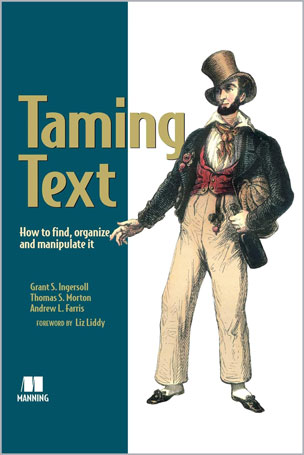
#Organize
#Manipulate
#Taming
#Text
Summary
Taming Text, winner of the 2013 Jolt Awards for Productivity, is a hands-on, example-driven guide to working with unstructured text in the context of real-world applications. This book explores how to automatically organize text using approaches such as full-text search, proper name recognition, clustering, tagging, information extraction, and summarization. The book guides you through examples illustrating each of these topics, as well as the foundations upon which they are built.
About this Book
There is so much text in our lives, we are practically drowning in it. Fortunately, there are innovative tools and techniques for managing unstructured information that can throw the smart developer a much-needed lifeline. You'll find them in this book.
Taming Text is a practical, example-driven guide to working with text in real applications. This book introduces you to useful techniques like full-text search, proper name recognition, clustering, tagging, information extraction, and summarization. You'll explore real use cases as you systematically absorb the foundations upon which they are built. Written in a clear and concise style, this book avoids jargon, explaining the subject in terms you can understand without a background in statistics or natural language processing. Examples are in Java, but the concepts can be applied in any language.
Written for Java developers, the book requires no prior knowledge of GWT.
Winner of 2013 Jolt Awards: The Best Books—one of five notable books every serious programmer should read.
What's Inside
"Takes the mystery out of very complex processes."—From the Foreword by Liz Liddy, Dean, iSchool, Syracuse University
Table of Contents
Grant Ingersoll is a founder of Lucid Imagination, developing search and natural language processing tools. Prior to Lucid Imagination, he was a Senior Software Engineer at the Center for Natural Language Processing at Syracuse University. At the Center and, previously, at MNIS-TextWise, Grant worked on a number of text processing applications involving information retrieval, question answering, clustering, summarization, and categorization. Grant is a committer, as well as a speaker and trainer, on the Apache Lucene Java project and a co-founder of the Apache Mahout machine-learning project. He holds a master's degree in computer science from Syracuse University and a bachelor's degree in mathematics and computer science from Amherst College.
Thomas Morton writes software and performs research in the area of text processing and machine learning. He has been the primary developer and maintainer of the OpenNLP text processing project and Maximum Entropy machine learning project for the last 5 years. He received his doctorate in Computer Science from the University of Pennsylvania in 2005, and has worked in several industry positions applying text processing and machine learning to enterprise class development efforts. Currently he works as a software architect for Comcast Interactive Media in Philadelphia.
Drew Farris is a professional software developer and technology consultant whose interests focus on large scale analytics, distributed computing and machine learning. Previously, he worked at TextWise where he implemented a wide variety of text exploration, management and retrieval applications combining natural language processing, classification and visualization techniques. He has contributed to a number of open source projects including Apache Mahout, Lucene and Solr, and holds a master's degree in Information Resource Management from Syracuse University's iSchool and a B.F.A in Computer Graphics.