ثبت نام / ورود
0
ثبت نام / ورود
0
Concepts, Principles, and Practices
Charles S. Wasson
#System_Engineering
#UCSD
#RMA
#SysMLTM
"This excellent text will be useful to every system engineer (SE) regardless of the domain. It covers ALL relevant SE material and does so in a very clear, methodical fashion. The breadth and depth of the author's presentation of SE principles and practices is outstanding." -Philip Allen
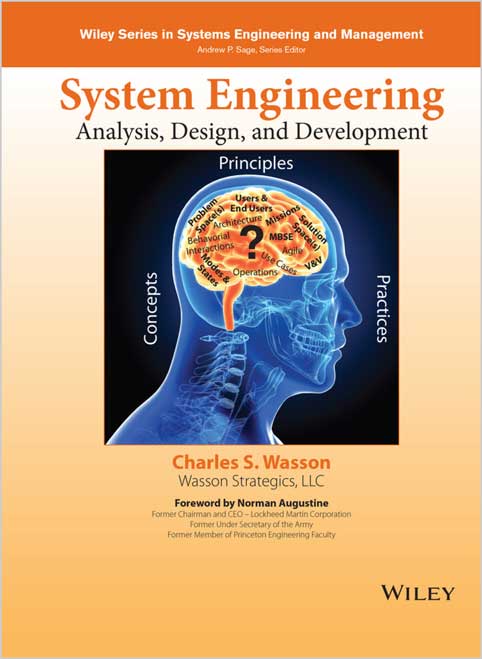
This textbook presents a comprehensive, step-by-step guide to System Engineering analysis, design, and development via an integrated set of concepts, principles, practices, and methodologies. The methods presented in this text apply to any type of human system - small, medium, and large Enterprise System development projects delivering Engineered Systems or services across multiple business sectors such as medical, energy, telecommunications, aerospace and defense, automotive, transportation, governmental, political, and charity, among others.
The objective of this book is to enable systems engineers, engineers, system analysts, project managers, and others to understand how Systems Engineering and Development (SE&D) are performed to improve their productivity and competitiveness in the marketplace. There is a solid examination of SE&D concepts, principles, processes, and practices used to evolve a System User's abstract operational need into a physical, field-operable system or product.
Topical discussions are supported by practical examples, observations, mini-case studies, lessons learned, and real-life events that illustrate how system engineering impacts technical and programmaticdecision-making and the Enterprise bottom line.
Highlights/introduces a new Twenty-First Century multi-discipline Systems Engineering & Development (SE&D) paradigm that is easy to understand and implement.
Provides a common focal point for "bridging the gap" between and unifying System Users, System Acquirers, multidiscipline System Engineering, and Project, Functional, and Executive Management education, knowledge, and decision making for developing systems, products, or services.
Each chapter provides definitions of key terms, guiding principles, examples, author's notes, real-world examples, and exercises, which highlight and reinforce key SE&D concepts and practices.
Addresses concepts employed in multi-discipline SE&D such as Model-Based Systems Engineering (MBSE), Unified Modeling Language (UMLTM)/Systems Modeling Language (SysMLTM), and Agile/Spiral/V-Model Development. Concepts include: Stakeholder Identification, Needs, User Stories, and Use Cases; System Life Cycle; Mission Analysis; ConOps Development; System Architecture Frameworks; System Phases, Modes and States; and Behavioral Modeling.
Provides practices that are critical staging area for technical decision making such as Technical Strategy Development; SE Process; Specification Development; Requirements Derivation, Allocation, Flow Down, and Traceability; System Architecture Development, User-Centric System Design (UCSD); Engineering Standards, Coordinate Systems, and Conventions; Interface Definition & Control; Reliability, Maintainability, and Availability (RMA); System Integration & Test; and Verification & Validation (V&V).
Thoroughly illustrated with graphics, end-of-chapter exercises, mini-case studies and examples, Systems Engineering Analysis, Design, and Development:
Concepts, Principles, and Practices, Second Edition is a valuable textbook for undergraduate/graduate level students and practitioners of multi-disciplined Systems Engineering.
Chapter 1 Systems, Engineering, and Systems Engineering
Chapter 2 The Evolving State of SE Practice-Challenges and Opportunities
Part I System Engineering and Analysis Concepts
Chapter 3 System Attributes, Properties, and Characteristics
Chapter 4 User Enterprise Roles, Missions, and System Applications
Chapter 5 User Needs, Mission Analysis, Use Cases, and Scenarios
Chapter 6 System Concepts Formulation and Development
Chapter 7 System Command and Control (C2) - Phases, Modes, and States of Operation
Chapter 8 System Levels of Abstraction, Semantics, and Elements
Chapter 9 Architectural Frameworks of the SOI and Its Operating Environment
Chapter 10 Modeling Mission System and Enabling System Operations
Chapter 11 Analytical Problem-Solving and Solution Development Synthesis
Part II System Engineering and Development Practices
Chapter 12 Introduction to System Development Strategies
Chapter 13 System Verification and Validation (V&V) Strategy
Chapter 14 The Wasson Systems Engineering Process
Chapter 15 System Development Process Models
Chapter 16 System Configuration Identification and Component Selection Strategy
Chapter 17 System Documentation Strategy
Chapter 18 Technical Reviews Strategy
Chapter 19 System Specification Concepts
Chapter 20 Specification Development Approaches
Chapter 21 Requirements Derivation, Allocation, Flow Down, and Traceability
Chapter 22 Requirements Statement Development
Chapter 23 Specification Analysis
Chapter 24 User-Centered System Design (UCSD)
Chapter 25 Engineering Standards of Units, Coordinate Systems, and Conventions
Chapter 26 System and Entity Architecture Development
Chapter 27 System Interface Definition, Analysis, Design, and Control
Chapter 28 System Integration, Test, and Evaluation (SITE)
Chapter 29 System Deployment, OM&S, Retirement, and Disposal
Part III Analytical Decision Support Practices
Chapter 30 Introduct ion to Analytical Decision Support
Chapter 31 System Performance Analysis, Budgets, and Safety Margins
Chapter 32 Trade Study Analysis of Alternatives (AoA)
Chapter 33 System Modeling and Simulation (M&S)
Chapter 34 System Reliability, Maintainability, and Availability (RMA)
CHARLES S. WASSON, BSEE, MBA, INCOSE FELLOW and ESEP, is a member of the INCOSE, ASEE, PMI, IEEE, and Tau Beta Pi and is President/Principal Consultant of Wasson Strategics, LLC. His professional career spans over 40 years of leadership in program/project management; system, hardware, and software design, development, integration, and test; and organizational and team development. Wasson Strategics (www. wassonstrategics.com) is a provider of multi-discipline SE, technical project management, and organizational and team development training and consulting services for clients ranging from small or medium to large Fortune 100 & 500 Enterprises striving to achieve System Engineering and Development excellence.