ثبت نام / ورود
0
ثبت نام / ورود
0
#UX_design
#product_design
#Storytelling
#Designing
#Defining
With the wide variety of devices, touch points, and channels in use, your ability to control how people navigate your well-crafted experiences is fading. Yet it’s still important to understand where people are in their journey if you’re to deliver the right content and interactions atthe right time and on the right device.
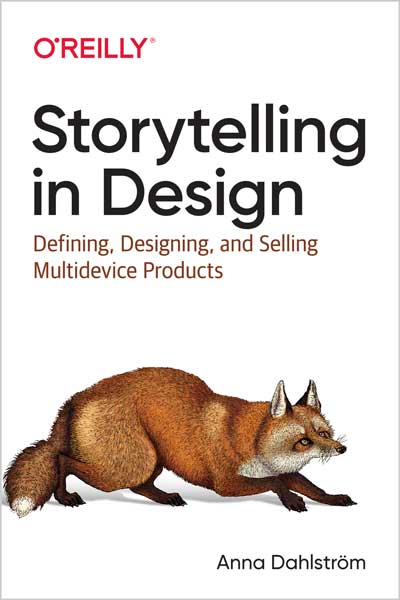
This practical guide shows you how storytelling can make a powerful difference in product design. Author Anna Dahlström details the many ways you can use storytelling in your projects and throughout your organization. By applying tried-and-tested principles from film and fiction to the context of design and business, you’ll learn to create great product experiences.
While many stories in the form of film, TV series, plays, novels, and books tend to come with happy endings, storytelling is increasingly moving outside its traditional form. A quick search on Google for “storytelling” and “business” returns around 122 million results, and there is no doubt that storytelling has become a buzzword in the business world over the last few years. However, as this book covers, it’s not without good reason. Stories have the power to make us see things, to move us emotionally as well as into action, and to make us process and remember facts. Responding to and telling stories is part of what makes us human.
As a business tool, storytelling is also incredibly important. We’ve all likely sat through horrific presentations that make us want to leave the room. Most of us have been impressed by someone who, on the other side of the spectrum, has delivered a great presentation and captured the attention of the whole room.
Today, being a good communicator, which essentially is being a good storyteller, is an increasingly sought-after skill. It impacts our ability to communicate with clients, team members, and internal stakeholders, whether we’re having day-to-day conversations or writing and giving great presentations. Being a good storyteller is something that is reflected in the work that we produce.
It’s also increasingly important when we look for that new role—from our own personal branding to the way we present ourselves and our work as well as in any portfolio. When it comes to work, we can all benefit from knowing how to tell a good story.
So what is it that sets a great story apart from an average or even a good one? What is it that makes the likes of Star Wars and The Shawshank Redemption become box office hits, and the likes of Harry Potter become such page turners? And what is it that makes certain TED talks the most watched of all time?
The question of what makes for a good story is what started the journey of this book. It’s a question I asked my dad when I was preparing for my first-ever storytelling talk. I wanted to find out if there was a magical recipe or formula to follow, besides a beginning, a middle, and an end. While I wasn’t expecting a “Well, yes there is!” answer, my dad’s response and the research it sparked turned out to be far more interesting than I could have imagined. Everywhere you look and everywhere you go, there is a story to tell. Exactly what makes for a great one and how this is connected to product design is the story I aim to tell you through this book.
As the world we’re designing for is becoming increasingly complex and automated, it is shifting what’s required of us as UX designers, product owners, strategists, founders, marketers, and more. Not only does our T-shaped form―a metaphor used to describe cross-skilled people who have expertise in at least one area (vertical bar) and are also knowledgeable in related areas (horizontal bar)―need to stretch a bit wider, but we also hold greater responsibility. In the words of product designer Wilson Miner:
We’re not just making pretty interfaces; we’re in the process of building an environment where we’ll spend most of our time, for the rest of our lives. We’re the designers, we’re the builders—what do we want that environment to feel like? What do we want to feel like? 2
To build and create great product experiences that deliver to both the user and to the business, we need to master Walt Disney’s ability to get the bigger picture right as well as the small details. We also need to account for a growing number of eventualities and moving parts that need to be defined and designed so that they all come together. Just like a good story. By turning to traditional storytelling, we can draw on tools, principles, and methods to help us―from character development (to help identify and define all the actors that play a part, including when and where), to narrative structure, main plots, and subplots for defining and designing for all eventualities. Happy and unhappy ones. And then, of course, there are set, scene, and shot design, which help us bring particular parts of a product or service experience to life. This all helps to ensure that the people who are or will be using our products and services will be the heroes of our stories, and who the experience is about.
Anna Dahlström is a Swedish UX designer based in London. She’s the founder of the UX design school UX Fika. Since 2001 she has worked client side, for agencies, and for startups on a large variety of brands and projects, from websites and apps to bots and TV UIs. She’s a regular speaker and holds a MSc in Computer Science and Business Administration from Copenhagen Business School.