ثبت نام / ورود
0
ثبت نام / ورود
0
George Casella, Roger L. Berger
#Statistical
#mathematics
#Probability_Theory
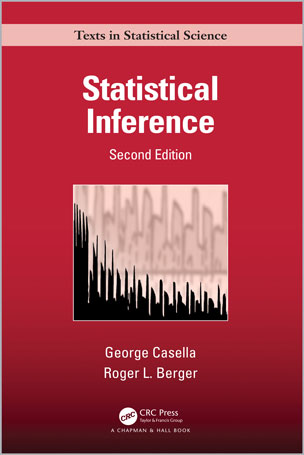
This book builds theoretical statistics from the first principles of probability theory. Starting from the basics of probability, the authors develop the theory of statistical inference using techniques, definitions, and concepts that are statistical and are natural extensions and consequences of previous concepts.
This book can be used for readers who have a solid mathematics background. It can also be used in a way that stresses the more practical uses of statistical theory, being more concerned with understanding basic statistical concepts and deriving reasonable statistical procedures for a variety of situations, and less concerned with formal optimality investigations.
Table of Contents
Chapter 1: Probability Theory
Chapter 2: Transformations and Expectations
Chapter 3: Common Families of Distributions
Chapter 4: Multiple Random Variables
Chapter 5: Properties of a Random Sample
Chapter 6: Principles of Data Reduction
Chapter 7: Point Estimation
Chapter 8: Hypothesis Testing
Chapter 9: Interval Estimation
Chapter 10: Asymptotic Evaluations
Chapter 11: Analysis of Variance and Regression
Chapter 12: Regression Models
"Statistical Inference is a delightfully modern text on statistical theory and deserves serious consideration from every teacher of a graduate- or advanced undergraduate-level first course in statistical theory. . . Chapters 1-5 provide plenty of interesting examples illustrating either the basic concepts of probability or the basic techniques of finding distribution. . . The book has unique features [throughout Chapters 6-12] for example, I have never seen in any comparable text such extensive discussion of ancillary statistics [Ch. 6], including Basu's theorem, dealing with the independence of complete sufficient statistics and ancillary statistics. Basu's theorem is such a useful tool that it should be available to every graduate student of statistics. . . The derivation of the analysis of variance (ANOVA)F test in Chapter 11 via the union-intersection principle is very nice. . . Chapter 12 contains, in addition to the standard regression model, errors-in-variables models. This topic will be of considerable importance in the years ahead, and the authors should be thanked for giving the reader an introduction to it. . . Another nice feature is the Miscellanea Section at the end of nearly every chapter. This gives the serious student an opportunity to go beyond the basic material of the text and look at some of the more advanced work on the topics, thereby developing a much better feel for the subject."