ثبت نام / ورود
0
ثبت نام / ورود
0
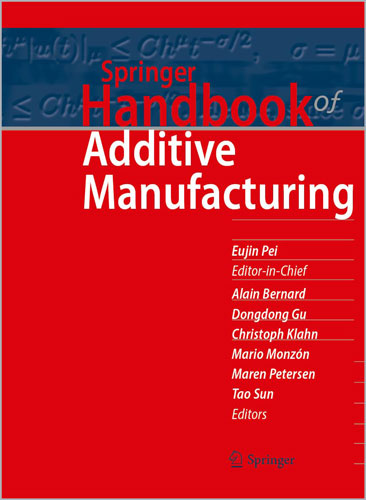
Eujin Pei, Alain Bernard, Dongdong Gu, Christoph Klahn, Mario Monzon, Maren Petersen, Tao Sun
#Additive_Manufacturing
This Handbook is the ultimate definitive guide that covers key fundamentals and advanced applications for Additive Manufacturing. The Handbook has been structured into seven sections, comprising of a thorough Introduction to Additive Manufacturing; Design and Data; Processes; Materials; Post-processing, Testing and Inspection; Education and Training; and Applications and Case Study Examples. The general principles and functional relationships are described in each chapter and supplemented with industry use cases. The aim of this book is to help designers, engineers and manufacturers understand the state-of-the-art developments in the field of Additive Manufacturing. Although this book is primarily aimed at students and educators, it will appeal to researchers and industrial professionals working with technology users, machine or component manufacturers to help them make better decisions in the implementation of Additive Manufacturing and its applications.
Part I: Introduction
1 History of AM
2 Economics of Additive Manufacturing
3 Business Model Innovation in Additive Manufacturing Equipment Sector
4 Implementation of Additive Manufacturing in Industry
5 Supply Chain Management for Additive Manufacturing
6 Intellectual Property Rights at Crossroads: The Copyright and Patent Implications Relating to 3D Printing
7 Technical Regulations and Policies Affecting AM
8 Benefits Using Additive Manufacturing
9 Opportunities and Limitations of Additive Manufacturing
10 Standards for Additive Manufacturing
11 ManuFUTURE
Part II: Design and Data
12 Design Guidelines
13 Identification of Suitable Parts
14 Modeling and Simulation for Additive Manufactured Parts
15 Production Process Chain from CAD to Part
16 Reverse Engineering
17 Strategies and Generative Design Towards the Development of Innovative Products
18 Topology Optimization
19 Security Threats in AM
Part III: Processes
20 Features, Limitat ions, Applications
21 Material Extrusion
22 Vat Photopolymerization
23 Material Jetting
24 Powder Bed Fusion
25 Sheet Lamination
26 Hybrid Manufacturing
27 Binder Jetting
28 Directed Energy Deposition
29 Quality Control in L-PBF for Industrial Production by Means of Production-Integrated Measurement Technology
30 Real-Time Monitoring of AM Processes
31 Environmental Health and Safety I
32 Environmental Health and Safety II
33 Environmental Health and Safety Ill
Part IV: Materials
34 Polymers for Additive Manufacturing
35 Thermoplastic Polymers and Polymer Composites Used in Selective Laser Sintering (SLS) Method
36 Ceramics
37 Composites (Fiber-Reinforced Plastic Matrix Composites)
38 Quality Control for Powder Bed Fusion Additive Manufacturing
39 Additive Manufacturing of Nickel Alloys
40 Additive Manufacturing of Titanium and Alloys
41 Powder Bed Fusion Additive Manufacturing of Stainless Steels
42 Additive Manufacturing of Aluminum Alloys
Part V: Post-processing, Testing, and Inspection
43 Microstructure and Property Characterization of AM Materials
44 Heat Treatment of Additive Manufactured Metals
45 Corrosion Behaviour of Additive Manufactured Metals
46 Part and Process Qualification for Serial Production
47 Quality Control for Additive Manufacturing
48 Post-processing for Additive Manufactured Metal Parts: A Brief Introduction
49 Post-processing Methods for Additive Manufactured Parts
Part VI: Education and Training
50 EU Funded Projects for Qualification and Standards Requirements in Additive Manufacturing
51 VET and Academic Training for Additive Manufacturing in Germany
52 Innovative Training to Support Adoption of Additive Manufacturing
53 Review of Additive Manufacturing Program Offerings in the United States
Part VII: Applications and Case Study Examples
54 Additive Manufacturing Applications and Case Study Examples
55 Additive Manufacturing in Cultural Heritage Preservation and Product Design
56 Tissue Engineering
57 Additive Manufacturing Applications for Art and Culture
58 Applications for Packaging
About the Authors
Dr Eujin Pei is a Reader in Additive Manufacturing at Brunel University London in the United Kingdom. He is the Associate Dean for the College of Engineering, Design and Physical Sciences, and Director for the BSc Product Design Engineering programme. He is a Chartered Engineer (CEng), Chartered Environmentalist (CEnv) and Chartered Technological Product Designer (CTPD). His research focuses on Design for Additive Manufacturing, 4D Printing and Sustainable Manufacturing.
Emeritus Professor Alain Bernard, graduated in 1982, with a PhD achieved in 1989. He worked as Associate-Professor from 1990 to 1996 at Centrale Paris. From 1996 to 2001, he was appointed as a Full Professor in CRAN, Nancy I, and led the “Integrated Design and Manufacturing” team. Since 2001, he worked as a Full Professor at Centrale Nantes and was Dean for Research from 2007 to 2012. He was a Researcher at LS2N Laboratory (UMR CNRS 6004), and former head of the “Systems Engineering –Products-Processes-Performances” team. Prof. Bernard’s research topics include Knowledge Management (KM), Product Lifecycle Management (PLM), information system modelling, enterprise modelling, systems performance assessment, virtual engineering and additive manufacturing.Prof. Dr.-Ing. Mario Monzón is a Doctor in Industrial Engineering and Full Professor in the Mechanical Engineering Department of the University of Las Palmas de Gran Canaria (ULPGC). He is the Director of the research group for Integrated and Advanced Manufacturing, which the main research fields cover polymer processing, Additive Manufacturing (AM), rapid tooling, natural fiber composites, biomaterials for Additive Manufacturing and bio-fabrication. He is a member of ISO TC261 and CEN TC438 committees the for standardization of AM technologies, representing Spain.
Dr. Tao Sun is an Associate Professor at the Department of Materials Science and Engineering of University of Virginia (UVA). Sun received PhD degree in Materials Science and Engineering from Northwestern University. Co-advised by Prof. Vinayak Dravid at Northwestern and Dr. Jin Wang at Argonne National Laboratory (ANL), Sun’ doctoral research focused on fabrication of nanostructured oxides using sol-gel based approaches, and characterization of these structures using advanced synchrotron x-ray techniques.
Prof. Dr.-Ing. Christoph Klahn is Full Professor for Additive Manufacturing (AM) in Process Engineering at Karlsruhe Institute of Technology KIT. He was the Head of Design for New Technologies at inspire AG, closely related to ETH Zürich, until 2021. His current research explores the opportunities of Additive Manufacturing in process engineering, as well as the implications of AM techniques on the development process of devices. In his interdisciplinary team, he explores the topics of design for AM, value creation and value identification, and the improvement of devices for process engineering by AM. He modifies AM processes and process chains to create novel material properties for functional integration and improved production processes.
Prof. Dr.-Ing. Maren Petersen is a Full Professor at the University of Bremen and a member of the Institute of Technology and Education (ITB) Executive Board. After graduating in Chemical Engineering, she focused on laser materials processing and Additive Manufacturing as a Research Assistant at the Institute of Laser and System Technologies (iLAS) at the Hamburg University of Technology (TUHH). Her doctoral research dealt with the Additive Manufacturing of metal-ceramic composites using laser beams and developed for quantifying new material systems for Additive Manufacturing with reduced effort.
Prof. Dr. Dongdong Gu is a Full Professor of Nanjing University of Aeronautics and Astronautics (NUAA) and the Director of Jiangsu Provincial Engineering Laboratory for Laser Additive Manufacturing of High-Performance Metallic Components.He was an Alexander von Humboldt Research Fellow at Fraunhofer ILT, Aachen, Germany from 2009 to 2011. His principal research interest is laser-based Additive Manufacturing of high-performance/multi-functional metallic components.