ثبت نام / ورود
0
ثبت نام / ورود
0
Non-Cartesian Coordinates
G. R. Liu
#Solid_Mechanics
#Python
#Coordinates
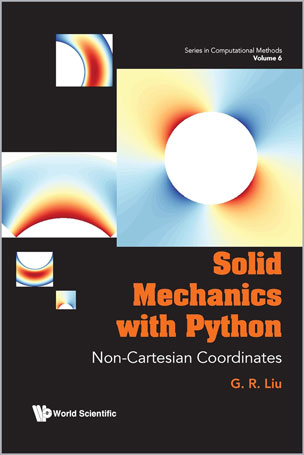
This comprehensive volume covers the fundamental principles of solid mechanics, focusing on the mechanical behavior of solids in two and three dimensions under various types of loads. The solids are defined in non-Cartesian coordinate systems, such as polar, cylindrical, and spherical coordinate systems.The methodology and techniques to solve solid mechanics problems are explained in detail, formulated and demonstrated with numerous examples and illustrations. Two major approaches, the stress method and the displacement method, are introduced. Python is used for formulation derivation, solving problems symbolically or numerically, and plotting results graphically.Written in Jupyter notebook format, this useful reference text offers a unified environment for theory description, code execution, and formulation, for easy reading and practicing.
Table of Contents
1. Introduction
2. Formulations in Non-Cartesian Coordinates
3. Stress Methods for Problems with Symmetry
4. Displacement Methods for Problems with Symmetry
5. Stress Method for Stress Concentration on a Hole
6. Displacement Methods for Non-axisymmetric Problems
7. Wedges Subjected to Forces
8. Half-Space Subjected to Surface Forces
9. Displacement Methods for Wedges
10. Displacement Method for an Arch Bridge
About the Author
G. R. Liu received his PhD from Tohoku University, Japan in 1991. He was a Postdoctoral Fellow at Northwestern University, U. S. A. He is currently the Director of the Centre for Advanced Computations in Engineering Science (ACES), National University of Singapore. He is the President of the Association for Computational Mechanics (Singapore), and an executive council member of the International Associate for Computational Mechanics. He is also a Professor at the Department of Mechanical Engineering, National University of Singapore. He has provided consultation services to many national and international organizations. He authored more than 500 technical publications including more than 330 international journal papers and eight authored books, including two bestsellers: "Meshfree Method: moving beyond the finite element method" and "Smoothed Particle Hydrodynamics: a Meshfree Particle Methods". He is the Editor-in-Chief of the International Journal of Computational Methods and an editorial member of five other journals including the IJNME. He is the recipient of the Outstanding University Researchers Awards, the Defence Technology Prize (National award), Silver Award at CrayQuest competition, the Excellent Teachers Awards, the Engineering Educator Awards, and the APACM Award for Computational Mechanics. His research interests include Computational Mechanics, Meshfree Methods, real-time computation, Nano-scale Computation, Micro bio-system computation, Vibration and Wave Propagation in Composites, Mechanics of Composites and Smart Materials, Inverse Problems and Numerical Analysis.