ثبت نام / ورود
0
ثبت نام / ورود
0
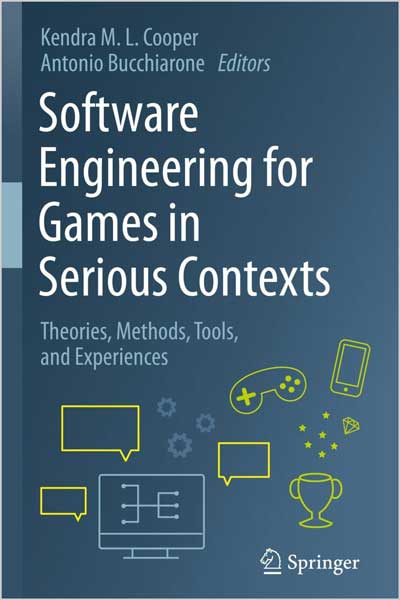
Theories, Methods, Tools, and Experiences
Kendra M. L. Cooper, Antonio Bucchiarone
#Software_Engineering
#Games
#Game_Design
The book highlights several challenges and opportunities in the field of software engineering for serious games. It covers a wide range of topics from game design principles to software architecture, testing, and deployment and is structured into two parts. While Part I delves into various aspects of designing, maintaining, adapting, and evaluating games in serious contexts; Part IIfocuses on the experiences of realizing and using games in serious contexts.
One of the primary challenges is to develop effective methods for evaluating serious games and measuring their impact and outcomes. Another challenge is to design serious games that are both engaging and effective, which requires a deep understanding of game design principles and instructional design. The book also emphasizes the need to develop effective software engineering practices for serious game development and the importance of gamification in improving user engagement and motivation. The potential of serious games for addressing societal challenges such as cybersecurity and healthcare is also highlighted. Despite these challenges, the book also identifies several opportunities for the field, including the potential of serious games to provide new and innovative approaches to learning and the potential of serious games to address real-world problems in new and effective ways.
Table of Contents
1 Introduction to Software Engineering for Games in SeriousContexts
13 Grand Challenges in Software Engineering for Games in Serious Contexts
Part I Topics on the Design, Maintenance, Adaptation, and Evaluation of Gameful Systems
2 User Experience Evaluation Methods for Games in SeriousContexts
3 Software Engineering for Dynamic Game Adaptation in Educational Games
4 Performance on Software Architecture Design to Serious Games for Mobile Devices
5 ENTRUST: Co-design and Validation of a Serious Game for Assessing Clinical Decision-Making and Readinessfor Entrustment
6 Engineering Adaptive Serious Games Using Machine Learning
Part II Topics on Experiences with Gameful Systems
7 Future Direct ions in Games for Serious Contexts: A Conversation About Transferability
8 Code-Venture: A Mobile Serious Game for Introductory Programming
9 Using Active Learning to Teach Software Engineering in Game Design Courses
10 A Framework for the Gamification of GUI Testing
11 Applying Leaderboards for Quality Improvement in Software Development Projects
K endra M. L. Cooper is an Independent Scholar whose research interests span software and systems engineering (requirements engineering and architecture) and engineering education; these topics are explored within the context of game engineering. Current topics include graph-based approaches such as biologically inspired adaptable software architecture models and ontological foundations for serious educational games. She has (co-)edited the books "Computer Games and Software Engineering" (2015) and "Software Engineering Perspectives in Computer Game Development" (2021), and has co-organized/organized ICSE Workshops on Games and Software Engineering and the CSEE&T Workshop on Essence in Education and Training.Antonio Bucchiarone is a Senior Researcher at the Motivational Digital Systems (MoDiS) research unit of the Bruno Kessler Foundation (FBK) in Trento, Italy. His research activity is focused on many aspects of Software Engineering. Current topics include advanced methodologies and techniques supporting the definition, development, and management of gameful systems in different domains (i.e., education, sustainable mobility, software modeling, etc..). He was the General Chair of the 12th IEEE International Conference on Self-Adaptive and Self Organizing Systems (SASO 2018) and has co-organized/organized multiple workshops at MODELS, ESEC/FSE, STAF and ICSE.