ثبت نام / ورود
0
ثبت نام / ورود
0
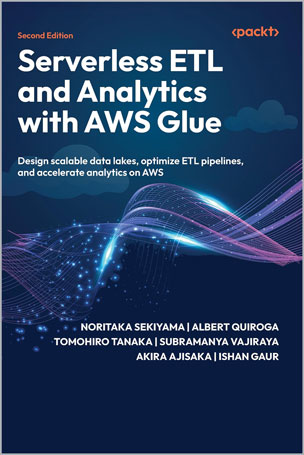
Design scalable data lakes, optimize ETL pipelines, and accelerate analytics on AWS
Noritaka Sekiyama, Albert Quiroga, Tomohiro Tanaka, Subramanya Vajiraya, Akira Ajisaka, Ishan Gaur
#Serverless
#AWS
#Analytics
#Glue
#ETL
#CI/CD
#CDK
Use AWS Glue to integrate growing data sources with serverless ETL, building secure, observable pipelines that support reliable analytics while managing performance and cost across a governed AWS data platform as workloads grow
Whether you build data pipelines, design cloud architectures, or deliver analytics on AWS, bringing data together is only part of the challenge. You must also keep this data clean, trustworthy, and available while controlling costs. AWS Glue offers serverless data integration, but using it effectively requires decisions about storage, metadata, security, orchestration, monitoring, and performance.
This book guides you from modern data management and core AWS Glue features through ingestion from files, streams, SaaS applications, and JDBC sources, preparation, storage layout, metadata, security, sharing, and pipeline operations. Console walkthroughs and runnable examples show how to manage schemas and lineage in AWS Glue Data Catalog, apply AWS Lake Formation access controls, monitor workloads, tune Spark jobs, troubleshoot failures, and manage development with AWS CDK, Docker, and CI/CD. You will also examine analytics, machine learning and generative AI integrations, real-world data lake scenarios, and cost optimization. Learn how Apache Iceberg, Apache Hudi, and Delta Lake add transactions, schema evolution, and efficient data management to data lakes.
By the end, you will be able to design, build, operate, and continuously improve a serverless data platform that fits your organization's scale, structure, and priorities.
This book is for data engineers, ETL developers, cloud architects, and analytics professionals who build or operate data platforms on AWS. It suits readers working on serverless data lakes, Spark ETL, governance, data sharing, reliability, or cost control. It is especially useful if you aim to improve pipeline reliability, governance, or cost visibility as workloads grow. Basic familiarity with the AWS Management Console, Amazon S3, and IAM is recommended. Experience with Python, SQL, or Apache Spark will help with the code examples, and an AWS account is useful for following the walkthroughs.
Table of Contents
Part I: Introduction, Concepts and Basics of AWS Glue
Chapter 1: Data Management – Introduction and Concepts
Chapter 2: Introduction to Important AWS Glue Features
Chapter 3: Data Ingestion
Part II: Data Preparation, Management and Security
Chapter 4: Data Preparation
Chapter 5: Data Layouts
Chapter 6: Data Management
Chapter 7: Implementing Resilient Metadata Management
Chapter 8: Data Security
Chapter 9: Data Sharing
Chapter 10: Data Pipeline Management
Part III: Tuning, Monitoring, and Real-World Scenarios
Chapter 11: Monitoring
Chapter 12: Tuning, Debugging, and Troubleshooting
Chapter 13: Data Analysis
Chapter 14: Machine Learning and Generative AI Integration
Chapter 15: Architecting Data Lakes for Real-World Scenarios and Edge Cases
Chapter 16: Managing End-to-End Development Lifecycle
Chapter 17: Open Table Formats
Chapter 18: Cost Optimization
Noritaka Sekiyama is an experienced big data engineer working at a data and AI company. He is responsible for building scalable data platforms with unified governance in the cloud. He is passionate about software engineering, cloud computing, big data technologies, distributed systems, data platforms, system monitoring, and automation.
Albert Quiroga is a Senior Solutions Architect at Amazon, where he creates solutions and architectural designs for one of the largest data lakes in the world. Prior to that, he spent four years working at AWS, where he specialized in big data technologies such as Amazon EMR, Amazon Athena, AWS Glue, and Amazon SageMaker. His 11 years of experience in the industry have empowered him to work with several Fortune 500 companies to overcome large-scale data and analytics challenges, and he has helped launch and develop features for several AWS services.
Tomohiro Tanaka is a big data specialist with deep, hands-on expertise in data infrastructure. His expertise covers large-scale migrations, performance tuning, and production troubleshooting, with a focus on Apache Spark and Apache Iceberg. He contributes to the Apache Iceberg open-source project and speaks at community events and conferences to help teams adopt Apache Iceberg in practice.
Subramanya Vajiraya is a Senior Cloud Engineer at AWS Sydney specializing in AWS Glue. He obtained his Bachelor of Engineering degree in Information Science & Engineering from NMAM Institute of Technology, Nitte, KA, India, in 2015 and his Master of Information Technology degree in Internetworking from the University of New South Wales, Sydney, Australia, in 2017. He is passionate about helping customers solve challenging technical issues related to their ETL workloads and implement scalable data integration and analytics pipelines on AWS.
Akira Ajisaka is a software engineer with more than 10 years of engineering experience in big data. He enjoys troubleshooting and contributing to OSS.
Ishan Gaur has more than 17 years of IT experience in software development, data engineering, and cloud architecture, building distributed systems and highly scalable data processing pipelines using Apache Spark, Scala, and various AWS data services, such as AWS Glue, Amazon SageMaker Unified Studio, and Amazon EMR. He currently works at AWS as a Principal Cloud Engineer, where he is focused on AI/ML operations and proactive cloud optimization. He works with AWS enterprise customers to design resilient data pipelines, automate incident response, troubleshoot large-scale distributed data platforms, and adopt GenAI-powered services and operational tools. He is passionate about turning reactive support patterns into proactive, self-healing architectures.