ثبت نام / ورود
0
ثبت نام / ورود
0
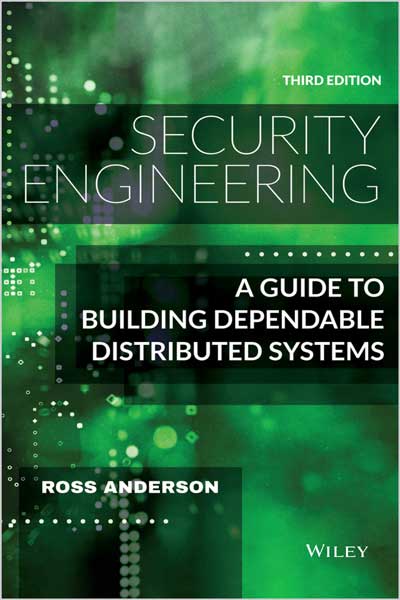
A Guide to Building Dependable Distributed Systems
Ross Anderson
#Security
#Engineering
#DevSecOps
#Distributed_Systems
#ORM
#Cryptographic
#Cryptography
Now that there's software in everything, how can you make anything secure? Understand how to engineer dependable systems with this newly updated classic
In Security Engineering: A Guide to Building Dependable Distributed Systems, Third Edition Cambridge University professor Ross Anderson updates his classic textbook and teaches readers how to design, implement, and test systems to withstand both error and attack.
This book became a best-seller in 2001 and helped establish the discipline of security engineering. By the second edition in 2008, underground dark markets had let the bad guys specialize and scale up; attacks were increasingly on users rather than on technology. The book repeated its success by showing how security engineers can focus on usability.
Now the third edition brings it up to date for 2020. As people now go online from phones more than laptops, most servers are in the cloud, online advertising drives the Internet and social networks have taken over much human interaction, many patterns of crime and abuse are the same, but the methods have evolved. Ross Anderson explores what security engineering means in 2020, including:
The third edition of Security Engineering ends with a grand challenge: sustainable security. As we build ever more software and connectivity into safety-critical durable goods like cars and medical devices, how do we design systems we can maintain and defend for decades? Or will everything in the world need monthly software upgrades, and become unsafe once they stop?
Contents
Chapter 1 What Is Security Engineering?
Chapter 2 Who Is the Opponent?
Chapter 3 Psychology and Usability
Chapter 4 Protocols
Chapter 5 Cryptography
Chapter 6 Access Control
Chapter 7 Distributed Systems
Chapter 8 Economics
Chapter 9 Multilevel Security
Chapter 1 0 Boundaries
Chapter 11 Inference Control
Chapter 12 Banking and Bookkeeping
Chapter 13 Locks and Alarms
Chapter 14 Monitoring and Metering
Chapter 15 Nuclear Command and Control
Chapter 16 Security Printing and Seals
Chapter 17 Biometrics
Chapter 18 Tamper Resistance
Chapter 19 Side Channels
Chapter 20 Advanced Cryptographic Engineering
Chapter 21 Network Attack and Defence
Chapter 22 Phones
Chapter 23 Electronic and Information Warfare
Chapter 24 Copyright and DRM
Chapter 20 Advanced Cryptographic Engineering
Chapter 21 Network Attack and Defence
Chapter 22 Phones
Chapter 23 Electronic and Information Warfare
Chapter 24 Copyright and ORM
Chapter 25 New Directions?
Chapter 26 Surveillance or Privacy?
Chapter 27 Secure Systems Development
Chapter 28 Assurance and Sustainability
Chapter 29 Beyond "Computer Says No"
Editorial Reviews
Security Engineering became a classic because it covers not just the technical basics, such as cryptography, access controls and tamper-resistance, but also how they're used in real life. Real-world case studies – of the security of payment systems, military systems, the phone app ecosystems and now self-driving cars – demonstrate how to use security technology in practice, and what can go wrong.
Filled with actionable advice and the latest research, this Third Edition brings a classic book up to date with the modern world of smartphones, cloud computing and AI. As everything gets connected to the Internet, security engineering has come to require inter-disciplinary expertise, ranging from physics to psychology and applied economics. Security Engineering is the only textbook on the market to explain all these aspects of protecting real systems, while still remaining easily accessible.
Perfect for computer science students and practicing cybersecurity professionals, as well as systems engineers of all sorts, this latest edition of Security Engineering also belongs on the bookshelves of candidates for professional certification such as CISSP.
You'll learn what makes a system secure and reliable and what can render it vulnerable, from phones and laptops through cars and payment terminals to cloud services and corporate networks. You'll find:
Security Engineering is the book that created the discipline. It will continue to define the discipline for the 2020s and beyond.
Ross Anderson is Professor of Security Engineering at Cambridge University in England. He is widely recognized as one of the world's foremost authorities on security. In 2015 he won the Lovelace Medal, Britain's top award in computing. He is a Fellow of the Royal Society and the Royal Academy of Engineering. He is one of the pioneers of the economics of information security, peer-to-peer systems, API analysis and hardware security. Over the past 40 years, he has also worked or consulted for most of the tech majors.