ثبت نام / ورود
0
ثبت نام / ورود
0
John Morgan, Gang Tian
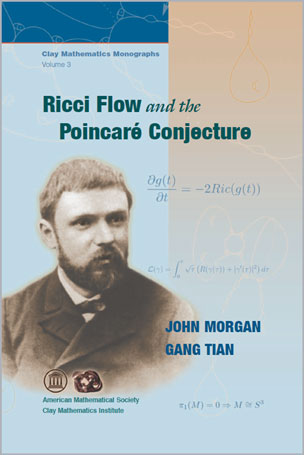
#Ricci
#Flow
#Poincare
#Conjecture
For over 100 years the Poincaré Conjecture, which proposes a topological characterization of the 3-sphere, has been the central question in topology. Since its formulation, it has been repeatedly attacked, without success, using various topological methods. Its importance and difficulty were highlighted when it was chosen as one of the Clay Mathematics Institute's seven Millennium Prize Problems.
In 2002 and 2003 Grigory Perelman posted three preprints showing how to use geometric arguments, in particular the Ricci flow as introduced and studied by Hamilton, to establish the Poincaré Conjecture in the affirmative. This book provides full details of a complete proof of the Poincaré Conjecture following Perelman's three preprints. After a lengthy introduction that outlines the entire argument, the book is divided into four parts. The first part reviews necessary results from Riemannian geometry and Ricci flow, including much of Hamilton's work.
The second part starts with Perelman's length function, which is used to establish crucial non-collapsing theorems. Then it discusses the classification of non-collapsed, ancient solutions to the Ricci flow equation. The third part concerns the existence of Ricci flow with surgery for all positive time and an analysis of the topological and geometric changes introduced by surgery. The last part follows Perelman's third preprint to prove that when the initial Riemannian 3-manifold has finite fundamental group, Ricci flow with surgery becomes extinct after finite time.
The proofs of the Poincaré Conjecture and the closely related 3-dimensional spherical space-form conjecture are then immediate. The existence of Ricci flow with surgery has application to 3-manifolds far beyond the Poincaré Conjecture. It forms the heart of the proof via Ricci flow of Thurston's Geometrization Conjecture. Thurston's Geometrization Conjecture, which classifies all compact 3-manifolds, will be the subject of a follow-up article. The organization of the material in this book differs from that given by Perelman.
From the beginning the authors present all analytic and geometric arguments in the context of Ricci flow with surgery. In addition, the fourth part is a much-expanded version of Perelman's third preprint; it gives the first complete and detailed proof of the finite-time extinction theorem.
With the large amount of background material that is presented and the detailed versions of the central arguments, this book is suitable for all mathematicians from advanced graduate students to specialists in geometry and topology. The Clay Mathematics Institute Monograph Series publishes selected expositions of recent developments, both in emerging areas and in older subjects transformed by new insights or unifying ideas. Titles in this series are co-published with the Clay Mathematics Institute (Cambridge, MA).
Table of Contents
Part 1. Background from Riemannian Geometry and Ricci flow
Chapter 1. Preliminaries from Riemannian geometry
Chapter 2. Manifolds of non-negative curvature
Chapter 3. Basics of Ricci flow
Chapter 4. The maximum principle
Chapter 5. Convergence results for Ricci flow
Part 2. Perelman’s length function and its applications
Chapter 6. A comparison geometry approach to the Ricci flow
Chapter 7. Complete Ricci flows of bounded curvature
Chapter 8. Non-collapsed results
Chapter 9. κ-non-collapsed ancient solutions
Chapter 10. Bounded curvature at bounded distance
Chapter 11. Geometric limits of generalized Ricci flows
Chapter 12. The standard solution
Part 3. Ricci flow with surgery
Chapter 14. Ricci Flow with surgery: the definition
Chapter 15. Controlled Ricci flows with surgery
Chapter 16. Proof of non-collapsing
Chapter 17. Completion of the proof of Theorem 15.9
Part 4. Completion of the proof of the Poincar´e Conjecture
Chapter 18. Finite-time extinction
Chapter 19. Completion of the Proof of Proposition 18.24
Review
"The comprehensive and carefully detailed nature of the text makes this book an invaluable resource for any mathematician who wants to understand the technical nuts and bolts of the proof, while the introductory chapter provides an excellent conceptual overview of the entire argument." ---- Mathematical Reviews