ثبت نام / ورود
0
ثبت نام / ورود
0
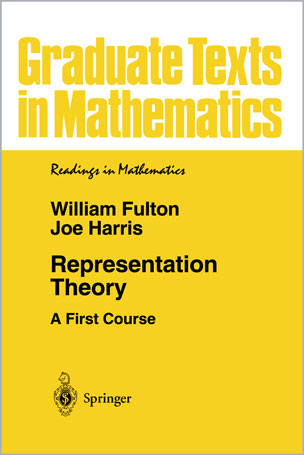
A First Course
William Fulton, Joe Harris
#Lie
#Groups
#Algebras
The primary goal of these lectures is to introduce a beginner to the finite dimensional representations of Lie groups and Lie algebras. Since this goal is shared by quite a few other books, we should explain in this Preface how our approach differs, although the potential reader can probably see this better by a quick browse through the book. Representation theory is simple to define: it is the study of the ways in which a given group may act on vector spaces. It is almost certainly unique, however, among such clearly delineated subjects, in the breadth of its interest to mathematicians. This is not surprising: group actions are ubiquitous in 20th century mathematics, and where the object on which a group acts is not a vector space, we have learned to replace it by one that is {e. g. , a cohomology group, tangent space, etc. As a consequence, many mathematicians other than specialists in the field {or even those who think they might want to be} come in contact with the subject in various ways. It is for such people that this text is designed. To put it another way, we intend this as a book for beginners to learn from and not as a reference. This idea essentially determines the choice of material covered here. As simple as is the definition of representation theory given above, it fragments considerably when we try to get more specific.
Table of Contents
Part I. Finite Groups
1. Representations of Finite Groups
2. Characters
3. Examples; Induced Representations; Group Algebras; Real Representations
4. Representations of Sd: Young Diagrams and Frobenius's Character Formula
5. Representations of Ad and GL2(Fq)
6. Weyl's Construction
Part II. Lie Groups and Lie Algebras
7. Lie Groups
8. Lie Algebras and Lie Groups
9. Initial Classification of Lie Algebras
10. Lie Algebras in Dimensions One, Two, and Three
11. Representations of sl2C
12. Representations of sl3C, Part I
13. Representations of sl3C, Part II: Mainly Lots of Examples
Part III. The Classical Lie Algebras and Their Representations
14. The General Set-up: Analyzing the Structure and Representations of an Arbitrary Semisimple Lie Algebra
15. sl4C and slnC
16. Symplectic Lie Algebras
17. sp6C and sp2nC
18. Orthogonal Lie Algebras
19. so6C, so7C, and somC
20. Spin Representations of somC
Part IV. Lie Theory
21. The Classification of Complex Simple Lie Algebras
22. g2 and Other Exceptional Lie Algebras
23. Complex Lie Groups; Characters
24. Weyl Character Formula
25. More Character Formulas
26. Real Lie Algebras and Lie Groups
Appendix A. On Symmetric Functions
Appendix B. On Multilinear Algebra
Appendix C. On Semisimplicity
Appendix D. Cartan Subalgebras
Appendix E. Ado's and Levi's Theorems
Appendix F. Invariant Theory for the Classical Groups
About the Authors
William Fulton William Fulton is a renowned American mathematician known for his important contributions to algebraic geometry, intersection theory, and representation theory. He has written several influential mathematical books, including Intersection Theory and Young Tableaux, which are widely used by students and researchers. His research has helped develop a deeper understanding of geometric and algebraic structures. He is also respected for his clear writing and significant influence on modern mathematics.
Joe Harris Joe Harris is a distinguished American mathematician and professor known for his contributions to algebraic geometry, particularly the study of algebraic curves, moduli spaces, and enumerative geometry. He has co-authored several important mathematical books, including Principles of Algebraic Geometry with Phillip Griffiths and Geometry of Algebraic Curves with William Fulton. His research has greatly influenced modern algebraic geometry, and he is recognized for his outstanding work in mathematical research and education.