ثبت نام / ورود
0
ثبت نام / ورود
0
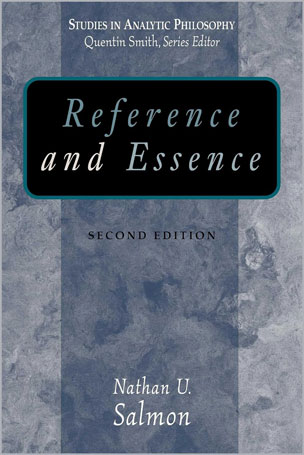
Nathan U. Salmon
#Reference
#Essence
#Philosophy
#Language
In this new edition of an important work in the philosophy of language, Nathan U Salmon, one of the leading proponents of what has come to be called the new or causal theory of reference, presents his latest thinking on this promising area of study.
Table of Contents
Part I. The Theory of Direct Reference
Section One. The Theory of Singular Direct Reference
1. A Formulation of the Theory
2. The Arguments
3. Rigid Designators
Section Two. The Theory Extended to General Terms
4. A Reformulation of the Theory
5. The Arguments Reconsidered
6. Rigid Designators Reconsidered
Section Three. Reference and the Necessary A Posteriori
7. Some Consequences of the Theory
8. Other Alleged Necessary A Posteriori Truths
9. A Crucial Question
Section Four. Putnam's Theory of Natural Kind Terms
10. Putnam's Theses
11. Initial Exegetical Remarks
12. First Formulations
13. Cross-World Relations
14. Reformulations
15. Further Exegetical Remarks
Part II. The Program to Derive Essentialism from the Theory of Reference
Section Five. The K and I Mechanisms
16. Putnam on (T9)
17. Donnellan's Elucidations of (T9)
18. The OK-Mechanism
19. The General K-Mechanism and the I-Mechanism
20. The Program
Section Six. Hidden Essentialism in the K and I Mechanisms
21. The First Two Premises
22. The Third Premise
23. The Failure of the Program
Section Seven. Arguments for the Essentiality of Origin
24. Kripke and the Putnam Program
25. Kripke's "Proof" of the Essentiality of Origin
26. Compossibility Principles and Cross-World Identification Principles
"Superior scholarship...reconstructs and clarifies recent arguments in an exemplary way. The thesis of the book (the underivability of essentialism from the theory of direct reference) is an exciting one, and forcefully argued. An invaluable work."
Nathan U. Salmon is professor of philosophy at the University of California at Santa Barbara. He is also the author of Frege’s Puzzle, numerous articles in analytic metaphysics and the philosophy of language, and the coeditor of Propositions and Attitudes.