ثبت نام / ورود
0
ثبت نام / ورود
0
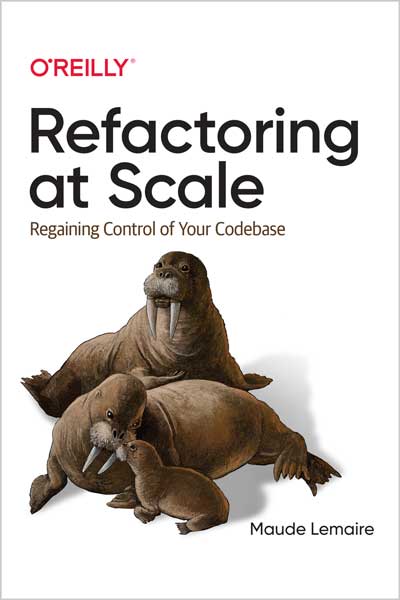
Regaining Control of Your Codebase
Maude Lemaire
#Refactoring
Making significant changes to large, complex codebases is a daunting task--one that's nearly impossible to do successfully unless you have the right team, tools, and mindset. If your application is in need of a substantial overhaul and you're unsure how to go about implementing those changes in a sustainable way, then this book is for you.
Software engineer Maude Lemaire walks you through the entire refactoring process from start to finish. You'll learn from her experience driving performance and refactoring efforts at Slack during a period of critical growth, including two case studies illustrating the impact these techniques can have in the real world. This book will help you achieve a newfound ability to productively introduce important changes in your codebase.
While there are a number of books about refactoring, most of them deal with the nitty-gritty of improving small bits of code one line at a time. I believe that the most difficult part of a refactor is usually not finding the precise way to improve the code at hand, but rather everything else that needs to happen around it. In fact, I might also go so far as to say that for any large software project, the little things rarely matter; coordinating complex changes is the biggest challenge of all.
Refactoring at Scale is my attempt at helping you figure out those difficult pieces. It’s the culmination of many years of experience carrying out all sorts of refactoring projects of various scales. During my time at Slack, many of the projects I’ve led have allowed the company to scale dramatically; our product has gone from being able to support customers with 25,000 employees to those with a whopping 500,000.
The strategies we developed to refactor effectively needed to tolerate explosive organizational growth, with our engineering team growing nearly sixfold during the same period. Successfully planning and executing on a project that affects both a significant portion of your codebase and an increasing number of engineers is no small feat.
I hope this book gives you the tools and resources you need to do just that.
Who Should Read This Book
If you work in a large, complex codebase alongside dozens (or more) of other engineers, this book is for you!
If you’re a junior engineer seeking ways to start building more senior skills by making a difference at your company, a large refactoring effort can be a great way to achieve that. These kinds of projects have broad, meaningful impact extending well beyond your individual team. (They’re also not so glamorous that a senior engineer might snap it up right away.) They’re a great opportunity for you to acquire new professional skills (and strengthen the ones you already have). This book will teach you how to navigate this kind of project smoothly from start to finish.
This book is also a valuable resource for highly technical senior engineers who can code themselves out of any problem, but are feeling frustrated that others aren’t understanding the value of their work. If you’re feeling isolated and are looking for ways to level-up others around you, this book can teach you the strategies you need to help others see important technical problems through your eyes.
For the technical managers seeking to help guide their team through a large-scale refactor, this book can help you understand how to better support your team every step of the way. There isn’t a substantial amount of technical content contained within these pages, so if you are involved with a large-scale refactor in just about any capacity (engineering manager, product manager, project manager), you can benefit from the ideas herein.
Maude Lemaire is a software engineer at Slack where she works to scale the product to support some of the world’s largest organizations. She spends most of her time chasing down people making network calls in a loop, refactoring unwieldy chunks of code, consolidating redundant database schemas, and building tools for other developers. Maude cares deeply about the developer experience and has actively sought out simpler, more efficient ways to structure code in each of her roles, at all levels of the stack.
Maude obtained a BSc. in Honours Software Engineering from McGill University.