ثبت نام / ورود
0
ثبت نام / ورود
0
Thomas Findlay
#React
Creating React apps might look easy. But creating large-scale React applications that are well-architectured and can be easily scaled and maintained not so much.
A lot of decisions taken throughout the development, especially those at the start, can have a huge impact on the success of a project. And there are a lot of them.
Choose the wrong tools for the project or add new features without a good architecture and patterns, and you will end up with a project which became a legacy before it was even shipped.
Instead of easily creating more features and keeping your users and stakeholders happy, you will need to fight with your project for years to come. But don't worry, there is a solution to that.
The internet is full of tutorials, articles and videos that try to teach React. The problem is that a lot of them are outdated, too simple or provide really bad advice and recommendations. That's not a good way to start an important project.
Fortunately, you don't need to do tons of research and try to pick and connect the dots yourself. There is a very simple answer to these problems.
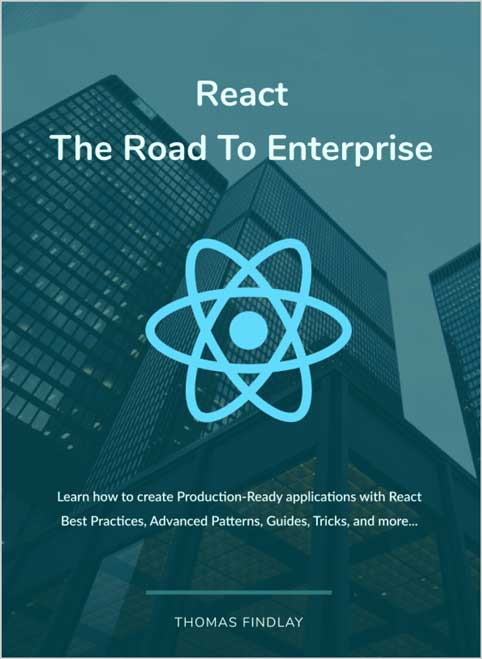
"React - The Road To Enterprise" is an advanced book that revolves around best practices, advanced patterns and techniques for the development of React and Next applications. It's a one-stop resource for many crucial concepts that should help you solve and avoid many pain-points when developing React applications.
Who is this book for?
"React - The Road To Enterprise" book is not a beginner's guide to React.js. It will not teach you how to get started with it. It's an advanced book, and to make the most out of this book, you should have at least basic knowledge of JavaScript, TypeScript and React.js, including concepts like hooks, state updates, lifecycles, etc. If you do not, then I first recommend getting to know React by going through the official documentation. You should also be comfortable with using a command-line interface.
The book is written with a very hands-on approach. I strongly believe that the best way to learn to code is by practice. There are a lot of code examples that you can follow along and play with yourself to gain a deeper understanding of the concepts behind them. You can do it either from scratch or by using the Companion App. If you are looking for a book to read on the go or simply away from your PC, then it might not be the best book for you.
• Developers with prior React knowledge who want to advance their React expertise and develop scalable, maintainable, and blazing fast React applications.
• Developers and teams who want to quickly get on board with best practices, patterns, and techniques to incorporate in their new or existing React projects.
• Developers who are looking for career progression as a React.js Developer.
Table of Contents
1. Introduction
2. Project Configuration and Useful Extensions
3. Scalable and Maintainable Project Architecture
4. API Layer and Managing Async Operations
5. Managing APIs with API Layer and React-Query
6. State Management Patterns in React Apps
7. Modern Redux - Global State Management with Redux Toolkit
8. Global State Management with Zustand and Jotai
9. Advanced Component Patterns
10. Managing Application Layout
11. Performance Optimisation
12. Application Security
13. React Testing - Best Practices For Writing Future-Proof Tests
14. Static Site Generation (SSG), Incremental Site Regeneration (ISR) and Server Side Rendering (SSR) with Next.js
What's in the book?
"React - The Road To Enterprise" covers many advanced topics to help you build maintainable, scalable and performant React applications, such as scalable project architecture, useful techniques for handling async operations and API states, advanced component patterns, performance optimisation, local and global state management patterns, static site generation (SSG), incremental site regeneration (ISR) and server side rendering (SSR) with Next.js and more.
Project Configuration and Scalable Architecture
Find out how to setup and configure an enterprise-ready project with tools such as PostCSS, Stylelint, Prettier and others. Learn how to create scalable architecture for your React applications that is actually easy to manage and extend.
Scalable and Maintainable API Requests and API States Management with an API Layer, Custom Hooks, and React-Query
Learn advanced patterns for managing async operations, API states, and request cancellation by implementing a flexible and scalable API layer and combining it with React-Query.
Advanced State Management Techniques
Master advanced state management techniques that will allow you to easily manage, share and reuse stateful data in your application. Explore patterns to manage state in a clean, readable and scalable fashion and take advantage of hooks, Immer and Context API.
Global State Management with Modern Redux and RTK
Forget about the pain of managing old Redux with tons of boilerplate code. Learn how to use Redux in a modern fashion with Redux Toolkit and RTK Query.
Global State management with Zustand & Jotai
Redux may be popular, but it is not the only viable solution. Explore how to use Zustand and Jotai for managing global and encapsulated state that can be shared between components.
Advanced Component and Layout Patterns
Discover advanced component patterns, such as Higher Order Components, Render Props, Compound Components, Polymorphic Components as well as how to manage dynamic layouts and how to build flexible, resilient and future proof components with Composition and Configuration approaches.
Performance Optimisation
Explore many essential techniques for improving and optimising the performance of your applications to make them blazing-fast and your users amazed - Optimising Re-renders, Long List Virtualisation, Throtting, Debouncing, Code-Splitting & Lazy Loading, and more!
SSG, ISR, SSR and Middlewares with Next.js
Find out the advantages of static site generated and server-side rendered applications and learn how to create them using Next.js. What's more, delve into how to take advantage of edge middlewares with Next.js
Testing & Security
Write reliable and future-proof unit and e2e tests with Jest, Cypress, and Testing Library that actually work and give you confidence. Make your applications more secure and explore ways of restricting access to specific pages and content only to authorised users.
TypeScript First
TypeScript is an amazing tool that is a must-have for large-scale applications. It provides a lot of benefits, as it makes the codebase more maintainable, readable, helps with catching bugs early in the development, and makes the refactoring process much easier. That's why, all code examples in the book are written in TypeScript.
Book Reviews
Most tutorials and books teach you fundamentals of React but they don't help much when it comes to best practices or how your code should scale to production levels. Not only will you learn how to code but you will see real applications, testing using modern industry techniques and a very in depth step by step guide showing you how to do everything. If your goal is to stand out in the Marketplace as a React developer, this is the book you should be reading to make that happen. 10/10 definitely recommend. Danny Thompson
"React - The Road to Enterprise" is a solid overview of useful patterns and key concepts for developing real-world React applications. Rather than yet another React intro tutorial, it covers practical techniques for topics like project structure, async requests using a home-grown and with React Query, state management with Redux and Zustand, routing, bundle management, security, and testing. It's an excellent resource for anyone who is comfortable with the basics of React and is ready to put those into practice in building meaningful applications. Mark Erikson
If you want to delve into design patterns and architecture of applications built on React, this is your book. It is very easy to read and the examples with code help to follow the explanations perfectly. 100% recommendable. Gerardo Fernández Moreno
I've been reading React - The Road To Enterprise from Thomas and so far I learned:
Great call buying the book. The quality is really top-notch, and it teaches non-trivial stuff that is relevant to our day-to-day job.
Definitely a gem. Go grab it if you are serious about web development! Juan Alvarez