ثبت نام / ورود
0
ثبت نام / ورود
0
R.A. Bertlmann, A. Zeilinger
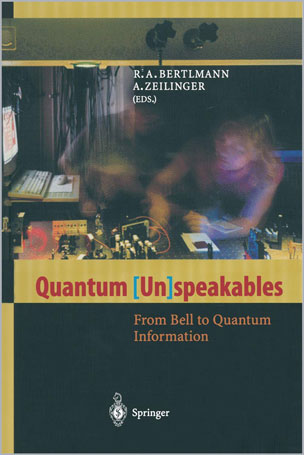
#Quantum
#Bell's_Theorem
#EPR_Paradox
issues raised by quantum theory, a topic not very popular during his student days at Queen's University, Belfast. Apparently, John Bell, who had been interested in the Bohr-Einstein dialogue, always took the position of Albert Einstein on philosophical issues. He also felt that a completion of quantum mechanics using so-called "hidden variables" would be highly desired, as it would help to regain a realistic and objective picture of the world. That way, Bell hoped one would be able to arrive at a physics where "measurement" would not play such a central role as in the Copenhagen interpretation of quantum mechanics. Then, a most interesting sequence of events set in. In 1952, David Bohm had achieved something which had earlier been proclaimed impossible. It had been proved by John von Neumann that no hidden variable theory could agree with quantum mechanics. Bohm actually formulated such a theory, where each particle at any time has both a well-defined position and a well defined momentum. The conflict raised between von Neumann and Bohm was elegantly resolved by Bell, who showed that von Neumann's proof contained a physically unjustifiable assumption. So while John Bell had flung open the door widely for hidden variable theories, he immediately dealt them a major blow. In 1964, in his celebrated paper "On the Einstein-Podolsky-Rosen Paradox", he showed that any hidden variable theory, which obeys Einstein's requirement of locality, i. e.
Table of Contents
Part I John S. Bell - The Man
1 Some Reminiscences
2 John Bell in Belfast: Early Years and Education
3 My Interaction with John Bell
4 Magic Moments: A Collaboration with John Bell
Part II Tests of Bell's Inequalities
5 John S. Bell: Some Reminiscences and Reflections
6 Early History of Bell's Theorem
7 On Four Decades of Interaction with John Bell
8 Atom Based Tests of the Bell Inequalities - the Legacy of John Bell Continues
9 Bell's Theorem: The Naive View of an Experimentalist
10 Bell's Theorem for Space-Like Separation
11 The EPR Paradox in Massive Systems or about Strange Particles
Part III Quantum Information
12 Are There Measurements?
13 Sundays in a Quantum Engineer's Life
14 Secret Sides of Bell's Theorem
15 An Impossible Necklace
16 Multi-Photon Entanglement and Quantum Non-Locality
17 Bell's Theorem, Information and Quantum Physics
Part IV Quantum Ideas
18 The Geometry of the Quantum Paradoxes
19 Whose Knowledge?
20 The History of the G HZ Paper
21 John Stewart Bell and the Dynamical Reduction Program
22 How Does God Play Dice?
(Pre-) Determinism at the Planck Scale
From the reviews of the first edition:
"The book leads the reader from the foundations of quantum mechanics to quantum entanglement, quantum cryptography, and quantum information, and is written for all whose who need insight into this new area of physics
"By reading this book it becomes clear that Bell was among the most brilliant physicists we had. Indeed a very exciting book, from the side of history as well as from the side of modern physics."
- Optik: Zeitschrift für Licht- und Elektronenoptik
"This book is a collection of articles commemorating the late John S. Bell, the brilliant physicist who was one of the originators of the second quantum revolution … . I have a hunch that this marvellous volume is destined to become a classic in the history of physics because it contains the thoughts and memoirs of practically all of the principal players who were involved with early developments … . they all write with great clarity and insight. … a marvellous read!" (A G Klein, The Physicist, Vol. 41 (1), 2003)
"Quantum [Un]speakables is the proceedings volume of a conference held at the University of Vienna in November 2000 to commemorate the 10th anniversary of Bell’s death. … The contributions focus very much on personal recollections … . The recollections make this book a valuable source both on John Bell the man and on the history of quantum physics between 1950 and 1990." (Nino Zanghi and Roderich Tumulka, American Scientist, September/October, 2003)