ثبت نام / ورود
0
ثبت نام / ورود
0
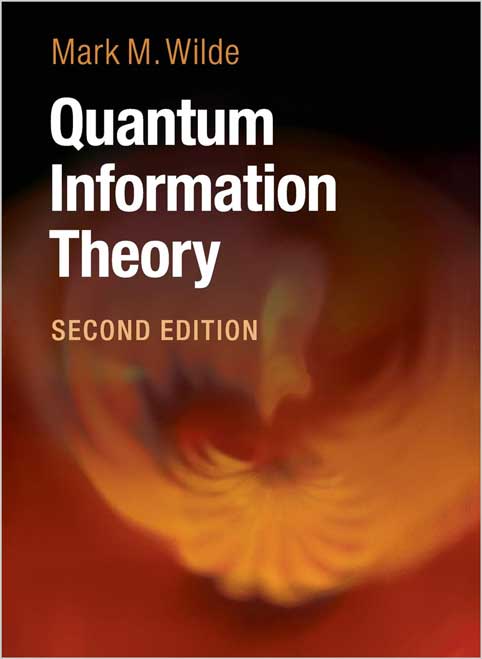
Mark M. Wilde
#Quantum
#Information_Theory
#Typicality
#Lemma
Developing many of the major, exciting, pre- and post-millennium developments from the ground up, this book is an ideal entry point for graduate students into quantum information theory. Significant attention is given to quantum mechanics for quantum information theory, and careful studies of the important protocols of teleportation, superdense coding, and entanglement distribution are presented. In this new edition, readers can expect to find over 100 pages of new material, including detailed discussions of Bell's theorem, the CHSH game, Tsirelson's theorem, the axiomatic approach to quantum channels, the definition of the diamond norm and its interpretation, and a proof of the Choi–Kraus theorem. Discussion of the importance of the quantum dynamic capacity formula has been completely revised, and many new exercises and references have been added. This new edition will be welcomed by the upcoming generation of quantum information theorists and the already established community of classical information theorists.
'For years, I have been hoping that somebody would write a book on quantum information theory that was clear, comprehensive, and up to date. This is that book. And the second edition is even better than the first.' Peter Shor, Massachusetts Institute of Technology
'Mark M. Wilde’s Quantum Information Theory is a natural expositor’s labor of love. Accessible to anyone comfortable with linear algebra and elementary probability theory, Wilde’s book brings the reader to the forefront of research in the quantum generalization of Shannon’s information theory. What had been a gaping hole in the literature has been replaced by an airy edifice, scalable with the application of reasonable effort and complete with fine vistas of the landscape below. Wilde’s book has a permanent place not just on my bookshelf but on my desk.' Patrick Hayden, Stanford University, California
Review of previous edition: ‘… [its] clear, thorough, and above all self-contained presentation will aid quantum information researchers in coming up to speed with the latest results in this area of the field. Meanwhile, the familiar setting and language will help classical information theorists who wish to become more acquainted with the quantum aspects of information processing … The presentation is well-structured, making it easy to jump to the desired topic and quickly determine on what that topic depends and how it is used going forward … Quantum Information Theory fills an important gap in the existing literature and will, I expect, help propagate the latest and greatest results in quantum Shannon theory to both quantum and classical researchers.' Joseph M. Renes, Quantum Information Processing
Review of previous edition: ‘… a modern self-contained text … suitable for graduate-level courses leading up to research level.' Journal of Discrete Mathematical Sciences and Cryptography
Review of previous edition: '… the book does a phenomenal job of introducing, developing and nurturing a mathematical sense of quantum information processing … In a nutshell, this is an essential reference for students and researchers who work in the area or are trying to understand what it is that quantum information theorists study. Wilde, as mentioned in his book, beautifully illustrates 'the ultimate capability of noisy physical systems, governed by the laws of quantum mechanics, to preserve information and correlations' through this book. I would strongly recommend it to anyone who plans to continue working in the field of quantum information.' Subhayan Roy Moulick, SIGCAT News
Table of Contents
Part I Introduction
1 Concepts in Quantum Shannon Theory
2 Classical Shannon Theory
Part II The Quantum Theory
3 The Noiseless Quantum Theory
4 The Noisy Quantum Theory
5 The Purified Quantum Theory
Part Ill Unit Quantum Protocols
6 Three Unit Quantum Protocols
7 Coherent Protocols
8 Unit Resource Capacity Region
Part IV Tools of Quantum Shannon Theory
9 Distance Measures
10 Classical Information and Entropy
11 Quantum Information and Entropy
12 Quantum Entropy Inequalities and Recoverability
13 The Information of Quantum Channels
14 Classical Typicality
15 Quantum Typicality
16 The Packing Lemma
17 The Covering Lemma
Part V Noiseless Quantum Shannon Theory
18 Schumacher Compression
19 Entanglement Manipulation
Part VI Noisy Quantum Shannon Theory
20 Classical Communication
21 Entanglement-Assisted Classical Communication
22 Coherent Communication with Noisy Resources
23 Private Classical Communication
24 Quantum Communication
25 Trading Resources for Communication
26 Summary and Outlook
Appendix A Supplementary Results
Appendix B Unique linear Extension of a Quantum Physical Evolution
Introduces many concepts and mathematical tools in quantum information theory, with over 100 pages of new material and exercises.
Mark M. Wilde is an Assistant Professor at the Department of Physics and Astronomy and the Center for Computation and Technology at Louisiana State University, Baton Rouge. He is the recipient of a National Science Foundation Career Development Award and the APS-IUSSTF Professorship Award in Physics. He is also a Senior Member of the IEEE, and is currently serving as Associate Editor for Quantum Information Theory for the leading journal IEEE Transactions on Information Theory. His current research interests are in quantum Shannon theory, quantum optical communication, quantum computational complexity theory, and quantum error correction.