ثبت نام / ورود
0
ثبت نام / ورود
0
Helge Kragh
#Quantum
#Generations
#Physics
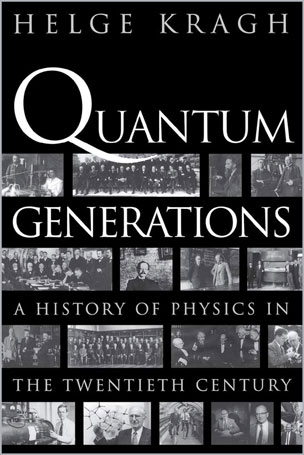
At the end of the nineteenth century, some physicists believed that the basic principles underlying their subject were already known, and that physics in the future would only consist of filling in the details. They could hardly have been more wrong. The past century has seen the rise of quantum mechanics, relativity, cosmology, particle physics, and solid-state physics, among other fields. These subjects have fundamentally changed our understanding of space, time, and matter. They have also transformed daily life, inspiring a technological revolution that has included the development of radio, television, lasers, nuclear power, and computers. In Quantum Generations, Helge Kragh, one of the world's leading historians of physics, presents a sweeping account of these extraordinary achievements of the past one hundred years.
The first comprehensive one-volume history of twentieth-century physics, the book takes us from the discovery of X rays in the mid-1890s to superstring theory in the 1990s. Unlike most previous histories of physics, written either from a scientific perspective or from a social and institutional perspective, Quantum Generations combines both approaches. Kragh writes about pure science with the expertise of a trained physicist, while keeping the content accessible to nonspecialists and paying careful attention to practical uses of science, ranging from compact disks to bombs. As a historian, Kragh skillfully outlines the social and economic contexts that have shaped the field in the twentieth century. He writes, for example, about the impact of the two world wars, the fate of physics under Hitler, Mussolini, and Stalin, the role of military research, the emerging leadership of the United States, and the backlash against science that began in the 1960s. He also shows how the revolutionary discoveries of scientists ranging from Einstein, Planck, and Bohr to Stephen Hawking have been built on the great traditions of earlier centuries.
Combining a mastery of detail with a sure sense of the broad contours of historical change, Kragh has written a fitting tribute to the scientists who have played such a decisive role in the making of the modern world.
Table of Contents
PART ONE: FROM CONSOLIDATION TO REVOLUTION
CHAPTER ONE Fin-de-Si`ecle Physics: A World Picture in Flux
CHAPTER TWO The World of P
CHAPTER THREE Discharges in Gases and What Followed
CHAPTER FOUR Atomic Archite
CHAPTER FIVE The Slow Rise of Quantum Theory
CHAPTER SIX Physics at Low Temperatures
CHAPTER SEVEN Einstein’s Relativity, and Others’
CHAPTER EIGHT A Revolution that Failed
CHAPTER NINE Physics in Industry and War
PART TWO: FROM REVOLUTION TO CONSOLIDATION
CHAPTER TEN Science and Politics in the Weimar Republic
CHAPTER ELEVEN Quantum Jumps
CHAPTER TWELVE The Rise of Nuclear Physics
CHAPTER THIRTEEN From Two to Many Particles
CHAPTER FOURTEEN Philosophical Implications of Quantum Mechanics
CHAPTER FIFTEEN Eddington’s Dream and Other Heterodoxies
CHAPTER SIXTEEN Physics and the New Dictatorships
CHAPTER SEVENTEEN Brain Drain and Brain Gain
CHAPTER EIGHTEEN From Uranium Puzzle to Hiroshima
PART THREE: PROGRESS AND PROBLEMS
CHAPTER NINETEEN Nuclear Themes
CHAPTER TWENTY Militarization and Megatrends
CHAPTER TWENTY ONE Particle Discoveries
CHAPTER TWENTY TWO Fundamental Theories
CHAPTER TWENTY THREE Cosmology and the Renaissance of Relativity
CHAPTER TWENTY FOUR Elements of Solid State Physics
CHAPTER TWENTY FIVE Engineering Physics and Quantum Electronics
CHAPTER TWENTY SIX Science under Attack Physics in Crisis?
CHAPTER TWENTY SEVEN Unifications and Speculations
PART FOUR: A LOOK BACK
CHAPTER TWENTY EIGHT Nobel Physics
CHAPTER TWENTY NINE A Century of Physics in Retrospect
Helge Kragh is Professor of History of Science at Aarhus University, Denmark. His previous books include An introduction to the Historiography of Science, Dirac A Scientific Biography, and Cosmology and Controversy: The Historical Development of Two Theories of the Universe (Princeton).