ثبت نام / ورود
0
ثبت نام / ورود
0
Tom Lancaster, Stephen J. Blundell
#Quantum_Field_Theory
#Amateur
#Statistical_physics
#QFT
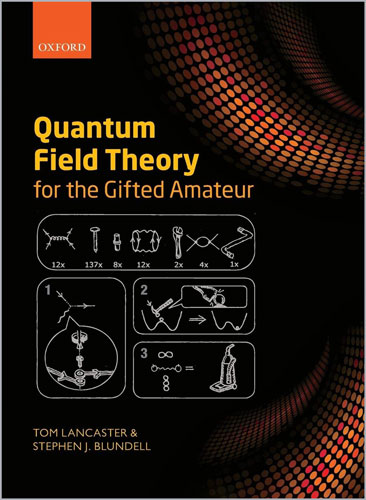
Quantum field theory is arguably the most far-reaching and beautiful physical theory ever constructed, with aspects more stringently tested and verified to greater precision than any other theory in physics. Unfortunately, the subject has gained a notorious reputation for difficulty, with forbidding looking mathematics and a peculiar diagrammatic language described in an array of unforgiving, weighty textbooks aimed firmly at aspiring professionals. However, quantum field theory is too important, too beautiful, and too engaging to be restricted to the professionals. This book on quantum field theory is designed to be different. It is written by experimental physicists and aims to provide the interested amateur with a bridge from undergraduate physics to quantum field theory. The imagined reader is a gifted amateur, possessing a curious and adaptable mind, looking to be told an entertaining and intellectually stimulating story, but who will not feel patronised if a few mathematical niceties are spelled out in detail. Using numerous worked examples, diagrams, and careful physically motivated explanations, this book will smooth the path towards understanding the radically different and revolutionary view of the physical world that quantum field theory provides, and which all physicists should have the opportunity to experience.
Table of Contents
Part I The Universe as a set of harmonic oscillators
1 Lagrangians
2 Simple harmonic oscillators
3 Occupation number representation
4 Making second quantization work
Part II Writing down Lagrangians
5 Continuous systems
6 A first stab at relat ivistic quantum mechanics
7 Examples of Lagrangians, or how to write down a theory
Part Ill The need for quantum fields
8 The passage of time
9 Quantum mechanical transformations
10 Symmetry
11 Canonical quantization of fields
12 Examples of canonical quantization
13 Fields with many components and massive electromagnet ism
14 Gauge fields and gauge theory
15 Discrete transformations
Part IV Propagators and perturbations
16 Propagators and Green's functions
17 Propagators and fields
18 The S-matrix
19 Expanding the S-matrix: Feynman diagrams
20 Scattering theory
Part V Interlude: wisdom from statistical physics
21 Statistical physics: a crash course
22 The generating functional for fields
Part VI Path integrals
23 Path integrals: I said to him, 'You're crazy'
24 Field integrals
25 Statistical field theory
26 Broken symmetry
27 Coherent states
28 Grassmann numbers: coherent states and the path integral for fermions
Part VII Topological ideas
29 Topological objects
30 Topological field theory
Part VIII Renormalization: taming the infinite
31 Renormalization, quasiparticles and the Fermi surface
32 Renormalization: the problem and its solution
33 Renormalization in action: propagators and Feynman diagrams
34 The renormalization group
35 Ferromagnetism: a renormalization group tutorial
Part IX Putting a spin on QFT
36 The Dirac equation
37 How to transform a spinor
38 The quantum Dirac field
39 A rough guide to quantum electrodynamics
40 QED scattering: three famous cross-sections
41 The renormalization of QED and two great results
Part X Some applications from the world of condensed matter
42 Superfluids
43 The many-body problem and the metal
44 Superconductors
45 The fractional quantum Hall fluid
Part XI Some applications from the world of particle physics
46 Non-abelian gauge theory
47 The Weinberg-Salam model
48 Majorana fermions
49 Magnetic monopoles
50 lnstantons, tunnelling and the end of the world
Tom Lancaster, Lecturer in Physics, Department of Physics, University of Durham,Stephen J. Blundell, Professor of Physics, Department of Physics, University of Oxford
Tom Lancaster was a Research Fellow in Physics at the University of Oxford, before becoming a Lecturer at the University of Durham in 2012.