ثبت نام / ورود
0
ثبت نام / ورود
0
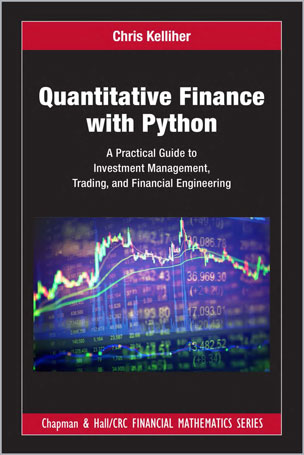
Practical Guide to Investment Management, Trading, and Financial Engineering
Chris Kelliher
#Finance
#Python
#Investment
#Management
#Trading
کتاب "امور مالی کمی با پایتون: راهنمای عملی برای مدیریت سرمایهگذاری، معاملات و مهندسی مالی" پلی است میان تئوری مالی ریاضی و کاربردهای عملی آن در قیمتگذاری مشتقات و مدیریت پرتفو. این کتاب، مقدمهای دقیق و کاملاً عملی بر موضوعات بنیادی مالی کمی، مانند قیمتگذاری اختیار معامله، بهینهسازی پرتفو و یادگیری ماشین، برای دانشجویان فراهم میکند. در عین حال، خواننده از تمرکز ویژه بر کاربردهای واقعی این مفاهیم در سرمایهگذاری نهادی نیز بهرهمند میشود.
Quantitative Finance with Python: A Practical Guide to Investment Management, Trading and Financial Engineering bridges the gap between the theory of mathematical finance and the practical applications of these concepts for derivative pricing and portfolio management. The book provides students with a very hands-on, rigorous introduction to foundational topics in quant finance, such as options pricing, portfolio optimization and machine learning. Simultaneously, the reader benefits from a strong emphasis on the practical applications of these concepts for institutional investors.
Features
Useful as both a teaching resource and as a practical tool for professional investors.
Ideal textbook for first year graduate students in quantitative finance programs, such as those in master’s programs in Mathematical Finance, Quant Finance or Financial Engineering.
Includes a perspective on the future of quant finance techniques, and in particular covers some introductory concepts of Machine Learning.
Free-to-access repository with Python codes available at www.routledge.com/ 9781032014432 and on
Table of Contents
SECTION I: Foundations of Quant Modeling
CHAPTER 1: Setting the Stage: Quant Landscape
CHAPTER 2: Theoretical Underpinnings of Quant Modeling: Modeling the Risk Neutral Measure
CHAPTER 3: Theoretical Underpinnings of Quant Modeling: Modeling the Physical Measure
CHAPTER 4: Python Programming Environment
CHAPTER 5: Programming Concepts in Python
CHAPTER 6: Working with Financial Datasets
CHAPTER 7: Model Validation
SECTION II: Options Modeling
CHAPTER 8: Stochastic Models
CHAPTER 9: Options Pricing Techniques for European Options
CHAPTER 10: Options Pricing Techniques for Exotic Options
CHAPTER 11: Greeks and Options Trading
CHAPTER 12: Extraction of Risk Neutral Densities
SECTION Ill: Quant Modeling in Different Markets
CHAPTER 13: Interest Rate Markets
CHAPTER 14: Credit Markets
CHAPTER 15: Foreign Exchange Markets
CHAPTER 16: Equity & Commodity Markets
SECTION IV: Portfolio Construction & Risk Management
CHAPTER 17: Portfolio Construction & Optimization Techniques
CHAPTER 18: Modeling Expected Returns and Covariance Matrices
CHAPTER 19: Risk Management
CHAPTER 20: Quantitative Trading Models
CHAPTER 21: Incorporating Machine Learning Techniques
Review
"This ambitious book is a practical guide for aspirant quants, on both the buyside and the sellside. It includes a 175-page supplement of code and exercises to provide a solid coding baseline.
The subject matter is neatly partitioned into 21 chapters, starting with an overview of the quant landscape and ending with basic machine learning in finance. The flow between chapters makes the book a pleasure to read, and readers can easily access topics of particular interest.
The author is both a lecturer and a practitioner in the field. This is evident from the accessible writing style, comprehensive examples, and the way topics are logically built up. The content strikes a good balance between theory and practice, covering a broad range of finance topics—from swaptions and currency triangles to CDO mechanics and feature explainability in machine learning. Few books in this space are as comprehensive.
Readers will find a strong selection of case studies throughout the book. The author's real-world experience enables him to write with conviction, and the commentary is accessible and free of jargon. These case studies, such as the 2018 natural gas options squeeze and the 2021 Reddit meme GameStop squeeze, are valuable cautionary tales for newcomers.
Finance students in their final years and those beginning careers as quants will find this book a useful resource. It may be considered an equally comprehensive but more practical complement to Hull’s classic Options, Futures, and Other Derivatives."
— Mark Greenwood, Quantitative Finance
About the Author
Chris Kelliher is a Senior Quantitative Researcher in the Global Asset Allocation group at Fidelity Investments. In addition, Mr. Kelliher is a Lecturer in the Masters in Mathematical Finance and Financial Technology program at Boston University's Questrom School of Business. In this role he teaches multiple graduate level courses including Computational Methods in Finance, Fixed Income & Programming for Quant Finance. Prior to joining Fidelity in 2019, Mr. Kelliher served as a portfolio manager for RDC Capital Partners. Before joining RDC, Mr. Kelliher served as a principal and quantitative portfolio manager at a leading quantitative investment management firm, FDO Partners. Prior to FDO, Mr. Kelliher was a senior quantitative portfolio analyst and trader at Convexity Capital Management and a senior quantitative researcher at Bracebridge Capital. He has been in the financial industry since 2004. Mr. Kelliher earned a BA in Economics from Gordon College, where he graduated Cum Laude with Departmental Honours, and an MS in Mathematical Finance from New York University's Courant Institute.
 ثناءالله خیری
kheili khoob mishod age sample ham mizaashtin az page ha va title haye ketab