ثبت نام / ورود
0
ثبت نام / ورود
0
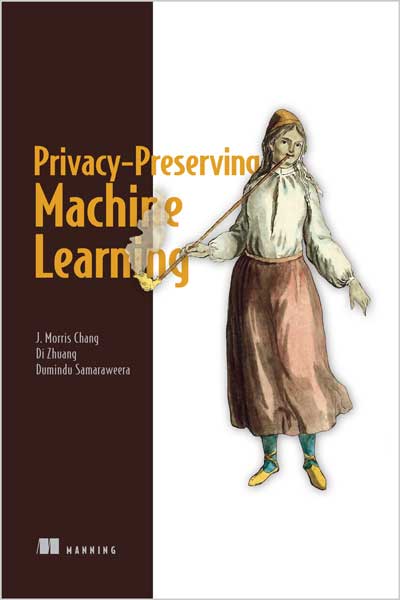
J. Morris Chang, Di Zhuang, Dumindu Samaraweera
#Machine_Learning
#data_mining
Keep sensitive user data safe and secure without sacrificing the performance and accuracy of your machine learning models.
In Privacy Preserving Machine Learning, you will learn:
Privacy-Preserving Machine Learning is a comprehensive guide to avoiding data breaches in your machine learning projects. You’ll get to grips with modern privacy-enhancing techniques such as differential privacy, compressive privacy, and synthetic data generation. Based on years of DARPA-funded cybersecurity research, ML engineers of all skill levels will benefit from incorporating these privacy-preserving practices into their model development. By the time you’re done reading, you’ll be able to create machine learning systems that preserve user privacy without sacrificing data quality and model performance.
About the Technology
Machine learning applications need massive amounts of data. It’s up to you to keep the sensitive information in those data sets private and secure. Privacy preservation happens at every point in the ML process, from data collection and ingestion to model development and deployment. This practical book teaches you the skills you’ll need to secure your data pipelines end to end.
About the Book
Privacy-Preserving Machine Learning explores privacy preservation techniques through real-world use cases in facial recognition, cloud data storage, and more. You’ll learn about practical implementations you can deploy now, future privacy challenges, and how to adapt existing technologies to your needs. Your new skills build towards a complete security data platform project you’ll develop in the final chapter.
What’s Inside
About the Reader
For machine learning engineers and developers. Examples in Python and Java.
"A detailed treatment of differential privacy, synthetic data generation, and privacy-preserving machine-learning techniques with relevant Python examples. Highly recommended!"
—Abe Taha, Google
"A wonderful synthesis of theoretical and practical. This book fills a real need."
—Stephen Oates, Allianz
"The definitive source for creating privacy-respecting machine learning systems. This area in data-rich environments is so important to understand!"
—Mac Chambers, Roy Hobbs Diamond Enterprises
"Covers all aspects for data privacy, with good practical examples."
—Vidhya Vinay, Streamingo Solutions
J. Morris Chang is a professor in the Department of Electrical Engineering of University of South Florida, Tampa, USA. He received his PhD from North Carolina State University. Since 2012, his research projects on cybersecurity and machine learning have been funded by DARPA and agencies under DoD. He has led a DARPA project under the Brandeis Program, focusing on privacy-preserving computation over the internet for three years.
Di Zhuang received his BSc degree in computer science and information security from Nankai University, Tianjin, China. He is currently a PhD candidate in the Department of Electrical Engineering of University of South Florida, Tampa, USA. He conducted privacy-preserving machine learning research under the DARPA Brandeis Program from 2015 to 2018.
G. Dumindu Samaraweera received his BSc degree in computer systems and networking from Curtin University, Australia, and a MSc in enterprise application development degree from Sheffield Hallam University, UK. He is currently reading for his PhD in electrical engineering at University of South Florida, Tampa.