ثبت نام / ورود
0
ثبت نام / ورود
0
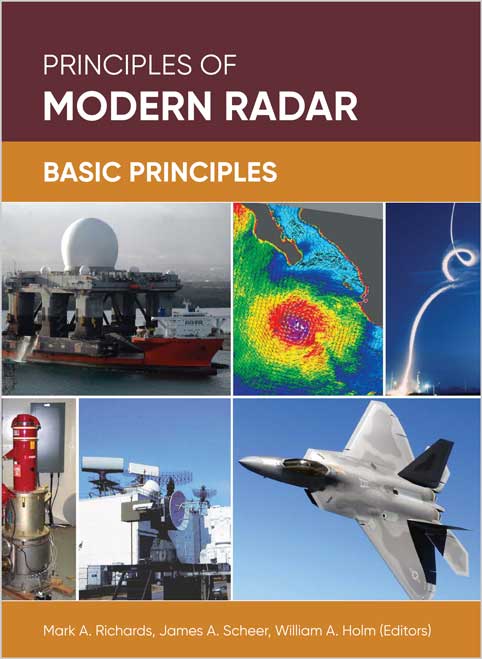
Vol. I: Basic Principles
Mark A. Richards, James A. Scheer, William A. Holm
#Radar
#MIMO
#Modern_Radar
#Radar_Design
Table of Contents
PART I: Overview
1. James A Scheer, William A Holm: Introduction and Radar Overview
2. James A Scheer: The Radar Range Equation
3. James A Scheer: Radar Search and Overview of Detection in Interference
PART II: External Factors
4. Jay A Saffold: Propagation Effects and Mechanisms
5. Nicholas C. Currie: Characteristics of Clutter
6. John F. Shaeffer: Target Reflectivity
7. Mark A Richards: Target Fluctuation Models
8. William A Holm, Mark A Richards: Doppler Phenomenology and Data Acquisition
PART Ill: Subsystems
9. Christopher D. Bailey: Radar Antennas
10. Tracy V. William , Randy J. Jost, and Paul E. Schmid: Radar Transmitters
11. Joseph A Bruder: Radar Receivers
12. James A Scheer: Radar Exciters
13. Mark A Richards: The Radar Signal Processor
PART IV: Signal and Data Processing
14. Mark A Richards: Digital Signal Processing Fundamentals for Radar
15. Mark A Richards: Threshold Detection of Radar Targets
16. Byron Murray Keel: Constant False Alarm Rate Detectors
17. Mark A Richards: Doppler Processing
18. W. Dale Blair, Mark A Richards, David G. Long: Radar Measurements
19. W. Dale Blair: Radar Tracking Algorithms
20. Byron Murray Keel: Fundamentals of Pulse Compression Waveforms
21. Gregory A Showman: An Overview of Radar Imaging
Appendix A. Maxwell's Equations and Decibel Notation
Appendix B. Answers to Selected Problems
William Melvin is Director of the Sensors and Electromagnetic Applications Laboratory at the Georgia Tech Research Institute and an Adjunct Professor in Georgia Tech's Electrical and Computer Engineering Department. His research interests include systems engineering, advanced signal processing and exploitation, and high-fidelity modeling and simulation. He has authored over 160 publications in his areas of expertise and holds three patents on adaptive radar technology. Among his distinctions, Dr. Melvin is a Fellow of the IEEE, with the follow citation: 'For contributions to adaptive signal processing methods in radar systems.' He received the Ph.D., M.S., and B.S. (with High Honors) degrees in Electrical Engineering from Lehigh University.
Jim Scheer has 40 years of hands-on experience in the design, development, and analysis of radar systems. He currently consults and works part time for GTRI and teaches radar-related short courses. He began his career with the General Electric Company (now Lockheed Martin Corporation), working on the F-111 attack radar system. In 1975 he moved to GTRI, where he worked on radar system applied research until his retirement in 2004. Mr. Scheer is an IEEE Life Fellow and holds a BSEE degree from Clarkson University and the MSEE degree from Syracuse University.