ثبت نام / ورود
0
ثبت نام / ورود
0
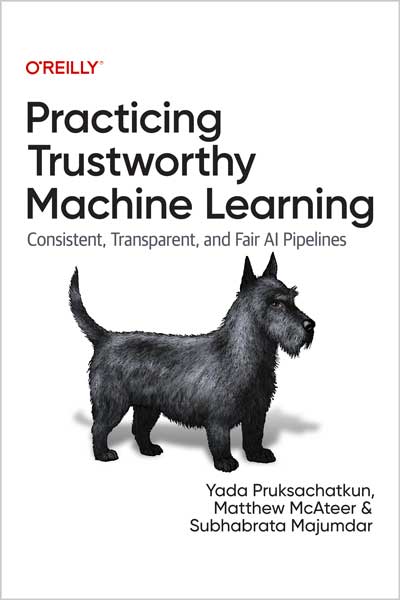
Consistent, Transparent, and Fair AI Pipelines
Yada Pruksachatkun, Matthew McAteer, Subhabrata Majumdar
#Machine_Learning
#ML
#AI
With the increasing use of AI in high-stakes domains such as medicine, law, and defense, organizations spend a lot of time and money to make ML models trustworthy. Many books on the subject offer deep dives into theories and concepts. This guide provides a practical starting point to help development teams produce models that are secure, more robust, less biased, and more explainable.
Authors Yada Pruksachatkun, Matthew McAteer, and Subhabrata Majumdar translate best practices in the academic literature for curating datasets and building models into a blueprint for building industry-grade trusted ML systems. With this book, engineers and data scientists will gain a much-needed foundation for releasing trustworthy ML applications into a noisy, messy, and often hostile world.
You'll learn:
We live in a world where machine learning (ML) systems are used in increasingly high-stakes domains like medicine, law, and defense. Model decisions can result in economic gains or losses in the millions or billions of dollars. Because of the high-stakes nature of their decisions and consequences, it is important for these ML systems to be trustworthy. This can be a problem when the ML systems are not secure, may fail unpredictably, have notable performance disparities across sample groups, and/or struggle to explain their decisions. We wrote this book to help your ML models stand up on their own in the real world.
Why We Wrote This Book
As people who have both conducted research in ML and worked on ML systems that have been successfully deployed, we’ve noticed that the gap between building an initial ML model for a static dataset and deployment is large. A major part of this gap is in lack of trustworthiness. There are so many ways in which ML models that work in development can fail in production. Many large companies have dedicated responsible AI and safety teams to analyze the potential risks and consequences of both their current and potential future ML systems.10 Unfortunately, the vast majority of teams and companies using ML do not have the bandwidth to do this. Even in cases where such teams exist, they are often underresourced, and the model development cycles may be too fast for the safety team to keep up with for fear that a competitor will release a similar model first.
We wrote this book to lower the barrier to entry for understanding how to create ML models that are trustworthy. While a lot of titles already exist on this subject, we wanted to create a resource that was accessible to people without a background in machine learning research that teaches frameworks and ways to think about trustworthiness, as well as some methods to evaluate and improve the trustworthiness of models. This includes:
While there’s no replacement for experience, in order to get experience, you need to know where to start in the first place. This book is meant to provide that much-needed foundation for releasing your machine learning applications into the noisy, messy, sometimes hostile real world. This work stands on the shoulders of countless other researchers, engineers, and more—we hope this work will help translate some of that work for people working to deploy ML systems.
Who This Book Is For
This book is written for anyone who is currently working with machine learning models and wants to be sure that the fruits of their labor will not cause unintended harm when released into the real world. The primary audience of the book is engineers and data scientists who have some familiarity with machine learning. Parts of the book should be accessible to non-engineers, such as product managers and executives with a conceptual understanding of ML. Some of you may be building ML systems that make higher-stakes decisions than you encountered in your previous job or in academia. We assume you are familiar with the very basics of deep learning and with Python for the code samples.
An initial reading will allow engineers to gain a solid understanding of trustworthiness and how it may apply to the ML systems you are using. As you continue on your ML career, you can refer back and adapt code snippets from the book to evaluate and ensure aspects of trustworthiness in your systems.
"An excellent practical book with code examples on making AI systems more fair, private, explainable, and robust. Impressively, it has kept up with the ongoing Cambrian explosion of foundation models."
-- Kush Varshney,
Distinguished Research Scientist, Foundations of Trustworthy AI, IBM Research
"This book is a valuable and concientiously written introduction to the increasingly important fields of AI safety, privacy, and interpretability, filled with lots of examples and code snippets to make it of practical use to machine learning practicioners."
-- Timothy Nguyen,
deep learning researcher, host of The Cartesian Cafe podcast
"This is an impressive book that feels simultaneously foundational and cutting-edge. It is a valuable reference work for data scientists and engineers who want to be confident that the models they release into the world are safe and fair."
-- Trey Causey,
Head of AI Ethics, Indeed
Yada Pruksachatkun is a machine learning scientist at Infinitus, a conversational AI startup that automates calls in the healthcare system. She has worked on trustworthy natural language processing as an Applied Scientist at Amazon, and led the first healthcare NLP initiative within mid-sized startup ASAPP. She did research transfer learning in NLP in graduate school at NYU and was advised by Professor Sam Bowman.
Matthew McAteer works on machine learning at Formic Labs, a startup focused on in silico cell simulation. He is also the creator of 5cube Labs, an ML consultancy that has worked with over 100 companies in industries ranging from architecture to medicine to agriculture. Matthew previously worked with the TensorFlow team at Google on probabilistic programming, and with the general-purpose AI research company Generally Intelligent. Before he was an ML engineer, Matthew worked in biomedical research labs at MIT, Harvard Medical School, and Brown University.
Subhabrata (Subho) Majumdar is a Senior Applied Scientist at Splunk. Previously, he spent 3 years in AT&T, where he led research and development on ethical AI. Subho deeply believes in the power of data to bring about positive changes in the world---he has cofounded the Trustworthy ML Initiative, and has been a part of multiple successful industry-academia collaborations in the data for good space. Subho holds a PhD in Statistics from the University of Minnesota.