ثبت نام / ورود
0
ثبت نام / ورود
0
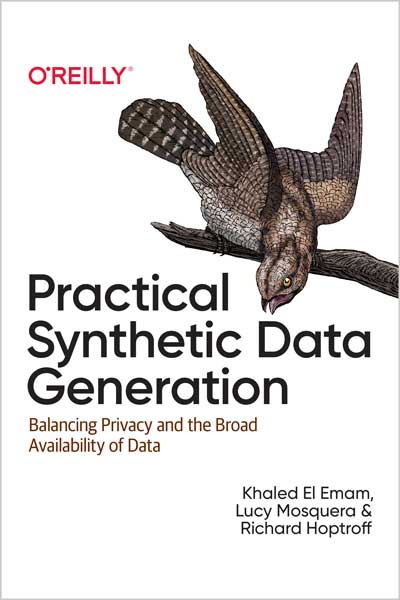
Balancing Privacy and the Broad Availability of Data
Khaled El Emam, Lucy Mosquera, Richard Hoptroff
#Data_Generation
#Data
#data_structure
#AIML
#machine_learning
#NVIDIA
#IBM
#Alphabet
Building and testing machine learning models requires access to large and diverse data. But where can you find usable datasets without running into privacy issues? This practical book introduces techniques for generating synthetic data—fake data generated from real data—so you can perform secondary analysis to do research, understand customer behaviors, develop new products, or generate new revenue.
Data scientists will learn how synthetic data generation provides a way to make such data broadly available for secondary purposes while addressing many privacy concerns. Analysts will learn the principles and steps for generating synthetic data from real datasets. And business leaders will see how synthetic data can help accelerate time to a product or solution.
This book describes:
Interest in synthetic data has been growing rapidly over the last few years. This interest has been driven by two simultaneous trends. The first is the demand for large amounts of data to train and build artificial intelligence and machine learning (AIML) models. The second is recent work that has demonstrated effective methods for generating high-quality synthetic data. Both have resulted in the recognition that synthetic data can solve some difficult problems quite effectively, especially within the AIML community. Companies like NVIDIA, IBM, and Alphabet, as well as agencies such as the US Census Bureau, have adopted different types of data synthesis methodologies to support model building, application development, and data dissemination.
This book provides you with a gentle introduction to methods for the following: generating synthetic data, evaluating the data that has been synthesized, understanding the privacy implications of synthetic data, and implementing synthetic data within your organization.
We show how synthetic data can accelerate AIML projects. Some of the problems that can be tackled by having synthetic data would be too costly or dangerous to solve using more traditional methods (e.g., training models controlling autonomous vehicles), or simply cannot be done otherwise. We also explain how to assess the privacy risks from synthetic data, even though they tend to be minimal if synthesis is done properly.
While we want this book to be an introduction, we also want it to be applied. Therefore, we will discuss some of the issues that will be encountered with real data, not curated or cleaned data. Real data is complex and messy, and data synthesis needs to be able to work within that context.
Our intended audience is analytics leaders who are responsible for enabling AIML model development and application within their organizations, as well as data scientists who want to learn how data synthesis can be a useful tool for their work. We will use examples of different types of data synthesis to illustrate the broad applicability of this approach. Our main focus here is on the synthesis of structured data.
Dr. Khaled El Emam is a senior scientist at the Children’s Hospital of Eastern Ontario (CHEO) Research Institute and Director of the multi-disciplinary Electronic Health Information Laboratory, conducting academic research on synthetic data generation methods, and re- identification risk measurement, and he is also a Professor in the Faculty of Medicine (Pediatrics) at the University of Ottawa.
He is the founder, CEO, and President of Privacy Analytics. Khaled has been performing data analysis since the early 90s, building statistical and machine learning models for prediction and evaluation. Since 2004 he has been developing technologies to facilitate the sharing of data for secondary analysis, from basic research on algorithms to applied solutions development that have been deployed globally. These technologies addressed problems in anonymization & pseudonymization, synthetic data, secure computation, and data watermarking. He has (co- )written multiple books on various privacy and software engineering topics. In 2003 and 2004, he was ranked as the top systems and software engineering scholar worldwide by the Journal of Systems and Software based on his research on measurement and quality evaluation and improvement. Previously, Khaled was a Senior Research Officer at the National Research Council of Canada. He also served as the head of the Quantitative Methods Group at the Fraunhofer Institute in Kaiserslautern, Germany. He held the Canada Research Chair in Electronic Health Information at the University of Ottawa from 2005 to 2015, and has a PhD from the Department of Electrical and Electronics Engineering, King’s College, at the University of London, England.
Lucy Mosquera has a bachelor's degree in Biology and Mathematics from Queen's University and is a current graduate student in the department of statistics at the University of British Columbia. During her time at Queen's, Lucy provided data management support on a dozen clinical trials and observational studies run through Kingston General Hospital's Clinical Evaluation Research Unit. Lucy has also worked on clinical trial data sharing methods based on homomorphic encryption and secret sharing protocols. At Replica Analytics, Lucy is responsible for developing statistical and machine learning models for data generation, and integrating subject area expertise in clinical trial data into synthetic data generation methods, as well as the statistical assessments of our synthetic data generation.
Dr. Richard Hoptroff is a long term technology inventor, investor and entrepreneur. Awarded a PhD in Physics by King’s College London for his work in optical computing and artificial intelligence, in 1992, together with Ravensbeck, he founded Right Information Systems, a neural network forecasting software company which was in 1997 sold to Cognos Inc (part of IBM). He then worked as a postdoc at the Research Laboratory for Archaeology and the History of Art at Oxford University and in 2001, created Flexipanel Ltd, a company supplying Bluetooth modules to the electronics industry.
In 2010, he founded the Hoptroff London, with the aim to develop smart, hyper-accurate watch movements and create a new watch brand. In 2013 he established a new commercial category when he brought to market the first commercial atomic timepiece and atomic wristwatch.
Hoptroff has now leveraged his expertise in timing technology and software to develop a hyper- accurate synchronised timestamping solution for the financial services sector, based on a unique combination of grandmaster atomic clock engineering and proprietary software.