ثبت نام / ورود
0
ثبت نام / ورود
0
Robert Harper
#Programming_Languages
#FPC
#PCF
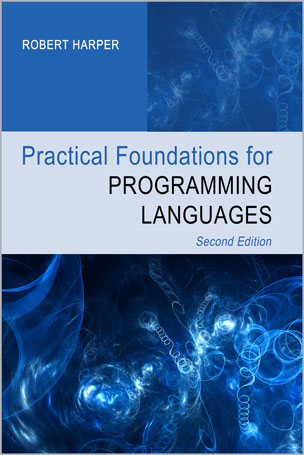
This text develops a comprehensive theory of programming languages based on type systems and structural operational semantics. Language concepts are precisely defined by their static and dynamic semantics, presenting the essential tools both intuitively and rigorously while relying on only elementary mathematics. These tools are used to analyze and prove properties of languages and provide the framework for combining and comparing language features. The broad range of concepts includes fundamental data types such as sums and products, polymorphic and abstract types, dynamic typing, dynamic dispatch, subtyping and refinement types, symbols and dynamic classification, parallelism and cost semantics, and concurrency and distribution. The methods are directly applicable to language implementation, to the development of logics for reasoning about programs, and to the formal verification language properties such as type safety. This thoroughly revised second edition includes exercises at the end of nearly every chapter and a new chapter on type refinements.
Table of Contents
Part I Judgments and Rules
1 Abstract Syntax
2 Inductive Definitions
3 Hypothetical and General Judgments
Part II Statics and Dynamics
4 Statics
5 Dynamics
6 Type Safety
7 Evaluation Dynamics
Part Ill Total Functions
8 Function Definitions and Values
9 System T of Higher-Order Recursion
Part IV Finite Data Types
10 Product Types
11 Sum Types
Part V Types and Propositions
12 Constructive Logic
13 Classical Logic
Part VI Infinite Data Types
14 Generic Programming
15 Inductive and Coinductive Types
Part VII Variable Types
16 System F of Polymorphic Types
17 Abstract Types
18 Higher Kinds
Part VIII Partiality and Recursive Types
19 System PCF of Recursive Functions
20 System FPC of Recursive Types
Part IX Dynamic Types
21 The Untyped 71-Calculus
22 Dynamic Typing
23 Hybrid Typing
Part X Subtyping
24 Structural Subtyping
25 Behavioral Typing
Part XI Dynamic Dispatch
26 Classes and Methods
27 Inheritance
Part XII Control Flow
28 Control Stacks
29 Exceptions
30 Continuations
Part XIII Symbolic Data
31 Symbols
32 Fluid Binding
33 Dynamic Classification
Part XIV Mutable State
34 Modernized Algol
35 Assignable References
36 Lazy Evaluation
Part XV Parallelism
37 Nested Parallelism
38 Futures and Speculations
Part XVI Concurrency and Distribution
39 Process Calculus
40 Concurrent Algol
41 Distributed Algol
Part XVII Modularity
42 Modularity and Linking
43 Singleton Kinds and Subkinding
44 Type Abstractions and Type Classes
45 Hierarchy and Parameterization
Part XVIII Equational Reasoning
46 Equality for System T
47 Equality for System PCF
48 Parametricity
49 Process Equivalence
Part XIX Appendices
A Background on Finite Sets
About the Author
Robert Harper is a professor in the Computer Science Department at Carnegie Mellon University. His main research interest is in the application of type theory to the design and implementation of programming languages and to the mechanization of their metatheory. Harper is a recipient of the Allen Newell Medal for Research Excellence and the Herbert A. Simon Award for Teaching Excellence, and is an Association for Computing Machinery Fellow.