ثبت نام / ورود
0
ثبت نام / ورود
0
Dennis H. Goldstein
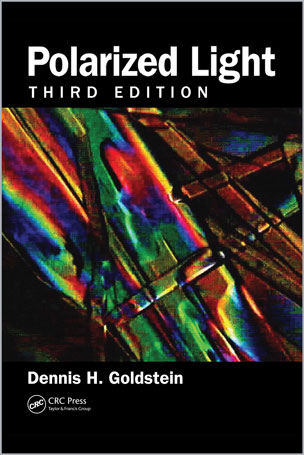
#Polarized
#Light
#Fresnel
#Arago
#Poincaré
#Polarimetry
#Electromagnetic
#Quantum
Polarized light is a pervasive influence in our world―and scientists and engineers in a variety of fields require the tools to understand, measure, and apply it to their advantage. Offering an in-depth examination of the subject and a description of its applications, Polarized Light, Third Edition serves as a comprehensive self-study tool complete with an extensive mathematical analysis of the Mueller matrix and coverage of Maxwell’s equations.
Links Historical Developments to Current Applications and Future Innovations
This book starts with a general description of light and continues with a complete exploration of polarized light, including how it is produced and its practical applications. The author incorporates basic topics, such as polarization by refraction and reflection, polarization elements, anisotropic materials, polarization formalisms (Mueller–Stokes and Jones) and associated mathematics, and polarimetry, or the science of polarization measurement.
New to the Third Edition:
Divided into four parts, this book covers the fundamental concepts and theoretical framework of polarized light. Next, it thoroughly explores the science of polarimetry, followed by discussion of polarized light applications. The author concludes by discussing how our polarized light framework is applied to physics concepts, such as accelerating charges and quantum systems.
Building on the solid foundation of the first two editions, this book reorganizes and updates existing material on fundamentals, theory, polarimetry, and applications. It adds new chapters, graphics, and color photos, as well as a new appendix on conventions used in polarized light. As a result, the author has re-established this book’s lofty status in the pantheon of literature on this important field.
Table of Contents
Part I Introduction to Polarized Light
Chapter 1. Introduction
Chapter 2. Polarization in the Natural Environment
Chapter 3. Wave Equation in Classical Optics
Chapter 4. The Polarization Ellipse
Chapter 5. Stokes Polarization Parameters
Chapter 6. Mueller Matrices for Polarizing Components
Chapter 7. Fresnel Equations: Derivation and Mueller Matrix Formulation
Chapter 8. Mathematics of the Mueller Matrix
Chapter 9. Mueller Matrices for Dielectric Plates
Chapter 10. The Jones Matrix Formalism
Chapter 11. The Poincaré Sphere
Chapter 12. Fresnel–Arago Interference Laws
Part II Polarimetry
Chapter 13. Introduction
Chapter 14. Methods of Measuring Stokes Polarization Parameters
Chapter 15. Measurement of the Characteristics of Polarizing Elements
Chapter 16. Stokes Polarimetry
Chapter 17. Mueller Matrix Polarimetry
Chapter 18. Techniques in Imaging Polarimetry
Chapter 19. Channeled Polarimetry for Snapshot Measurements
Part III Applications
Chapter 20. Introduction
Chapter 21. Crystal Optics
Chapter 22. Optics of Metals
Chapter 23. Polarization Optical Elements
Chapter 24. Ellipsometry
Chapter 25. Form Birefringence and Meanderline Retarder
Part IV Classical and Quantum Theory of Radiation by Accelerating Charges
Chapter 26. Introduction to Classical and Quantum Theory of Radiation by Accelerating Charges
Chapter 27. Maxwell’s Equations for Electromagnetic Fields
Chapter 28. The Classical Radiation Field
Chapter 29. Radiation Emitted by Accelerating Charges
Chapter 30. Radiation of an Accelerating Charge in the Electromagnetic Field
Chapter 31. The Classical Zeeman Effect
Chapter 32. Further Applications of the Classical Radiation Theory
Chapter 33. The Stokes Parameters and Mueller Matrices for Optical Activity and Faraday Rotation
Chapter 34. Stokes Parameters for Quantum Systems
About the Author
Dr. Dennis Goldstein is a senior physicist with Polaris Sensor Technologies, Inc., following a 28-year career in electro-optics research at the Air Force Research Laboratory. He is a fellow of SPIE and AFRL, and has served as an adjunct professor at the University of Arizona and University of Florida. He also teaches short courses for the Georgia Institute of Technology. In addition to Polarized Light, Dr. Goldstein has published more than 70 papers and technical reports, and two book chapters. He holds six patents.