ثبت نام / ورود
0
ثبت نام / ورود
0
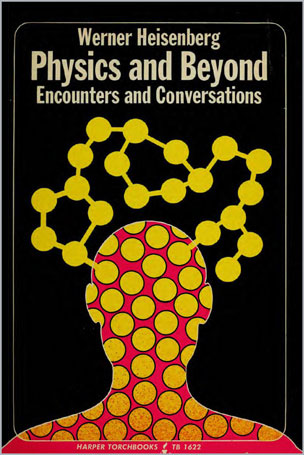
Encounters and Conversations
Werner Heisenberg, Arnold J. Pomerans (Translator)
#Physics
#Conversations
#Quantum_Mechanics
This is one of the most fascinating books written by a major physicist. It is not simply a book about quantum mechanics. It explores the relationship between science, philosophy, human consciousness, language, ethics, politics, and the nature of reality.
1. What is the book about?
Heisenberg recounts the development of modern physics through conversations with some of the greatest scientific minds of the twentieth century.
Among the people whose ideas and discussions feature in the book are:
The conversations are reconstructed rather than verbatim transcripts. Heisenberg aims to preserve their intellectual substance and atmosphere.
Table of Contents
1. First Encounter with the Atomic Concept (1919–1920)
2. The Decision to Study Physics (1920)
3. "Understanding" in Modern Physics (1920–1922)
4. Lessons in Politics and History (1922–1924)
5. Quantum Mechanics and a Talk with Einstein (1925–1926)
6. Fresh Fields (1926–1927)
7. Science and Religion (1927)
8. Atomic Physics and Pragmatism (1929)
9. The Relationship between Biology, Physics and Chemistry (1930–1932)
10. Quantum Mechanics and Kantian Philosophy (1930–1934)
11. Discussions about Language (1933)
12. Revolution and University Life (1933)
13. Atomic Power and Elementary Particles (1935–1937)
14. Individual Behavior in the Face of Political Disaster (1937–1941)
15. Toward a New Beginning (1941–1945)
16. The Responsibility of the Scientist (1945–1950)
17. Positivism, Metaphysics and Religion (1952)
18. Scientific and Political Disputes (1956–1957)
19. The Unified Field Theory (1957–1958)
20. Elementary Particles and Platonic Philosophy (1961–1965)
About the Author
Werner Heisenberg (1901–1976) was a German theoretical physicist and one of the founders of quantum mechanics. He is best known for formulating the uncertainty principle in 1927, which established a fundamental limit on the precision with which certain pairs of physical properties, such as position and momentum, can be simultaneously known. He received the Nobel Prize in Physics in 1932 for his contributions to the creation of quantum mechanics. Beyond his scientific achievements, Heisenberg was deeply interested in philosophy, particularly the relationship between science, reality, knowledge, and human understanding. His intellectual exchanges with leading scientists, including Niels Bohr and Albert Einstein, profoundly influenced modern physics. In his book Physics and Beyond: Encounters and Conversations, he reflects on these encounters and explores the philosophical, ethical, and human dimensions of scientific discovery.