ثبت نام / ورود
0
ثبت نام / ورود
0
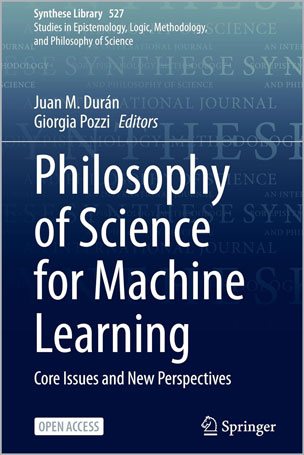
Core Issues and New Perspectives
Juan M. Durán, Giorgia Pozzi
#Philosophy
#Science
#Machine_Learning
#ML
#Al
#XAI
This open access book offers a comprehensive and systematic debate on the key concepts and areas of application of the philosophy of science for machine learning. The current landscape of the debate about the epistemic and methodological challenges raised by machine learning in scientific fields is fragmented and lacks a common thread that helps to understand the complexity of the issue. Against this background, this book brings together expert researchers in the field, structuring the debate in ways that allow readers to navigate quickly in this evolving field of research and pave the way to new paths of philosophical and technical research. Although the book is written from the perspective of philosophy of science and epistemology, it is of interest to philosophers in a myriad of fields, such as philosophy of mind, philosophy of language, philosophy of neuroscience, and metaphysics of science, STS studies, as well as to researchers working on technical and computational issues such as explainability, trustworthiness, interpretability, transparency.
Table of Contents
Part I Epistemic Opacity
1 In Which Ways Is Machine Learning Opaque?
2 How I Stopped Worrying and Learned to Love Opacity
3 Epistemic Opacity and Scientific Realism and Anti-Realism
Part II Justification
4 Beyond Transparency: Computational Reliabilism as an Externalist Epistemology of Algorithms
5 Challenges for Computational Reliabilism in Al and Other Computational Methods
6 Can XAI Justify?
Part III Scientific Explanation (XAI)
7 Axe the X in XAI: A Plea for Understandable Al
8 Machine Learning Models as Mathematics: Interpreting Explainable Al in Non-causal Terms
9 From Explanations to lnterpretability and Back
Part IV Scientific Understanding and lnterpretability
10 Explanation Hacking: The Perils of Algorithmic Recourse
11 Stakes and Understanding the Decisions of Artificial Intelligent Systems
Part V Scientific Models and Representation
I 12 Representation Learning Without Representationalism
13 Artificial Neural Nets and the Representation of Human Concepts
14 Defining Formal Validity Criteria for Machine Learning Models
Part VI Scientific Practice and Scientific Values in ML
15 Why Are Human Epistemic Agents Not Displaced in Machine Learning Scientific Inquiries? A Practice Perspective on ML in Science
16 Values, Inductive Risk, and Societal-Epistemic Coupledness in Machine Learning Models
17 Machine Learning and the Ethics of Induction
Part VII ML in the Particular Sciences
18 Beyond Classification and Prediction: The Promise of Physics-Informed Machine Learning in Astronomy andCosmology
19 Machine Learning Discoveries and Scientific Understanding in Particle Physics: Problems and Prospects
20 Don't Fear the Bogeyman: On Why There Is No Prediction-Understanding Trade-Off for Deep Learning in Neuroscience
21 Artificial Intelligence in Climate Science: From Machine Learning to Neural Networks
22 Machine Learning in Public Health and the Prediction-Intervention Gap
Juan M. Durán is an Assistant Professor at the Delft University of Technology. His work has focused on the intersection between philosophy of science and technology, first with computer simulations and more recently with machine learning. He also has extensive work on the ethics of technology. In 2019 he was awarded the Herbert A. Simon Award for outstanding research in computing and philosophy. This award is offered by the International Association for Computing and Philosophy (IACAP) and recognizes scholars at an early stage of their academic career who are likely to reshape debates at the nexus of computing and philosophy with their original research. He has held visiting fellowships at the University of Virginia, Tilburg University, and the Netherlands Institute for Advanced Studies in the Humanities and Social Sciences. His current work focuses on developing Computational Reliabilism, a theoretical framework for the justification of our belief in the output of machine learning.
Giorgia Pozzi is a Ph.D. Candidate at TU Delft working at the intersection between the ethics and epistemology of explanatory AI, with a particular interest in machine-learning implementations in the field of medicine and healthcare. Among others, her research focuses on injustices that can emerge in connection to ML in healthcare, particularly due to the epistemic limitations of ML systems. Furthermore, she is interested in questions regarding the bearing of epistemic justification on moral justification in AI-based medical decision-making. She is thus interested in making explicit and investigating in-depth the conflating and intertwined nature of epistemology and ethics in the context of AI. Before joining TU Delft, she obtained a Bachelor's degree in Philosophy (focusing on moral philosophy and metaethics) and in Chinese Studies at Ludwig-Maximilians-University (LMU) in Munich. Afterwards, she completed her Master’s focusing on the ethics and epistemology of artificial intelligence at the same universi