ثبت نام / ورود
0
ثبت نام / ورود
0
Vincent C. Müller
#Artificial_Intelligence
#Philosophy
#AI
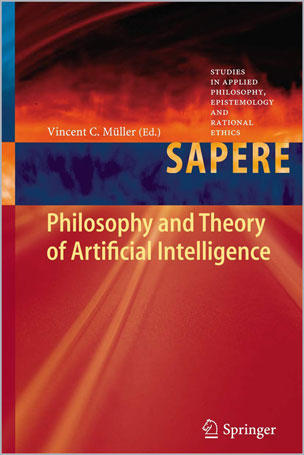
Can we make machines that think and act like humans or other natural intelligent agents? The answer to this question depends on how we see ourselves and how we see the machines in question. Classical AI and cognitive science had claimed that cognition is computation, and can thus be reproduced on other computing machines, possibly surpassing the abilities of human intelligence. This consensus has now come under threat and the agenda for the philosophy and theory of AI must be set anew, re-defining the relation between AI and Cognitive Science.
We can re-claim the original vision of general AI from the technical AI disciplines; we can reject classical cognitive science and replace it with a new theory (e.g. embodied); or we can try to find new ways to approach AI, for example from neuroscience or from systems theory. To do this, we must go back to the basic questions on computing, cognition and ethics for AI. The 30 papers in this volume provide cutting-edge work from leading researchers that define where we stand and where we should go from here.
Computation and Method
Machine Mentality?
Cognition
Ethics and Society
About the Author
Vincent C. Müller is AvH Professor for Philosophy and Ethics of AI and Director of the Centre for Philosophy and AI Research (PAIR) at FAU Erlangen-Nuremberg - as well as Visiting Professor at TU Eindhoven, Turing Fellow at the Alan Turing Institute (London), President of the European Society for Cognitive Systems and Chair of the euRobotics topics group on 'ethical, legal and socio-economic issues'. He was Professor at the Technical University of Eindhoven (2019-22) and at Anatolia College/ACT (Thessaloniki) (1998-2019), as well as James Martin Research Fellow at the University of Oxford (2011-15) and Stanley J. Seeger Fellow at Princeton University (2005-6). Müller studied philosophy with cognitive science, linguistics and history at the universities of Marburg, Hamburg, London and Oxford.
Müller works mainly on philosophical problems connected to artificial intelligence, both in ethics and in theoretical philosophy. His publications are cited >1/day. Müller edits the "Oxford handbook of the philosophy of artificial intelligence" (OUP), wrote the Stanford Encyclopedia of Philosophy article on Ethics of AI and Robotics and has a book forthcoming with OUP on "Can Machines Think?", as well as a book with CUP on "Artificial Minds" (with G. Löhr). He frequently presents invited talks around the world and he has organised ca. 25 conferences or workshops, among them a prominent conference series on the Philosophy and Theory of AI (PT-AI). Currently, Müller is one of the 32 experts on the Global Partnership on AI (GPAI) and he is a member of the OECD Network of Experts on AI. In 2022, he was awarded the personal science prize "Alexander von Humboldt Professor", worth €3.5M, together with a professorship and matching funds from the university (ca. €1.5M). He has generated ca. €9.8M research income for his institutions.