ثبت نام / ورود
0
ثبت نام / ورود
0
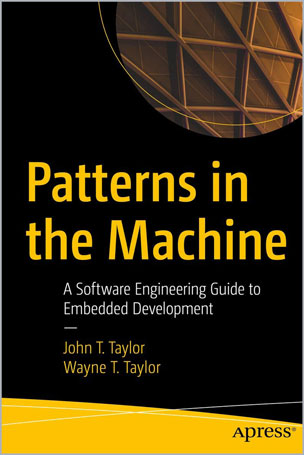
A Software Engineering Guide to Embedded Development
#Patterns
#Machine
#Software_Engineering
#Data
#C++
Discover how to apply software engineering patterns to develop more robust firmware faster than traditional embedded development approaches. In the authors’ experience, traditional embedded software projects tend towards monolithic applications that are optimized for their target hardware platforms. This leads to software that is fragile in terms of extensibility and difficult to test without fully integrated software and hardware. Patterns in the Machine focuses on creating loosely coupled implementations that embrace both change and testability.
This book illustrates how implementing continuous integration, automated unit testing, platform-independent code, and other best practices that are not typically implemented in the embedded systems world is not just feasible but also practical for today’s embedded projects.
After reading this book, you will have a better idea of how to structure your embedded software projects. You will recognize that while writing unit tests, creating simulators, and implementing continuous integration requires time and effort up front, you will be amply rewarded at the end of the project in terms of quality, adaptability, and maintainability of your code.
What You Will Learn
Who This Book Is For
Mid-level or higher embedded systems (firmware) developers, technical leads, software architects, and development managers.
Table of Contents
Chapter 1: Introduction
Chapter 2: Core Concepts
Chapter 3: Design Theory for Embedded Programming
Chapter 4: Persistent Storage Detailed Design Example
Chapter 5: Software Architecture
Chapter 6: Unit Testing
Chapter 7: Functional Simulator
Chapter 8: Continuous Integration
Chapter 9: The Data Model Architecture
Chapter 10: Finite State Machines
Chapter 11: Documentation
Chapter 12: File Organization and Naming
Chapter 13: More About Late Binding
Chapter 14: Initialization and the Main Pattern
Chapter 15: More Best Practices
Chapter 16: Pl M Thermostat Example
Chapter 17: The Tao of Development
Appendix A: Terminology
Appendix B: State Machine Notation
Appendix C: A UML Cheat Sheet
Appendix D: Why C++
Appendix E: About Package Management with Outcast
Appendix F: Requirements vs. Design Statements
John Taylor has been an embedded developer for over 29 years. He has worked as a firmware engineer, technical lead, system engineer, software architect, and software development manager for companies such as Ingersoll Rand, Carrier, Allen-Bradley, Hitachi Telecom, Emerson, and several start-up companies. He has developed firmware for products that include HVAC control systems, telecom SONET nodes, IoT devices, micro code for communication chips, and medical devices. He is the co-author of five US patents and holds a bachelor’s degree in mathematics and computer science.
Wayne Taylor has been a technical writer for 25 years. He has worked with companies such as IBM, Novell, Compaq, HP, EMC, SanDisk, and Western Digital. He has documented compilers, LAN driver development, storage system deployment and maintenance, and dozens of low-level and system-management APIs. He also has ten years of experience as a software development manager. He is the co-author of two US patents and holds master’s degrees in English and human factors. He is a co-author of OS/2 and NetWare Programming (Van Nostrand Reinhold, 1995).